
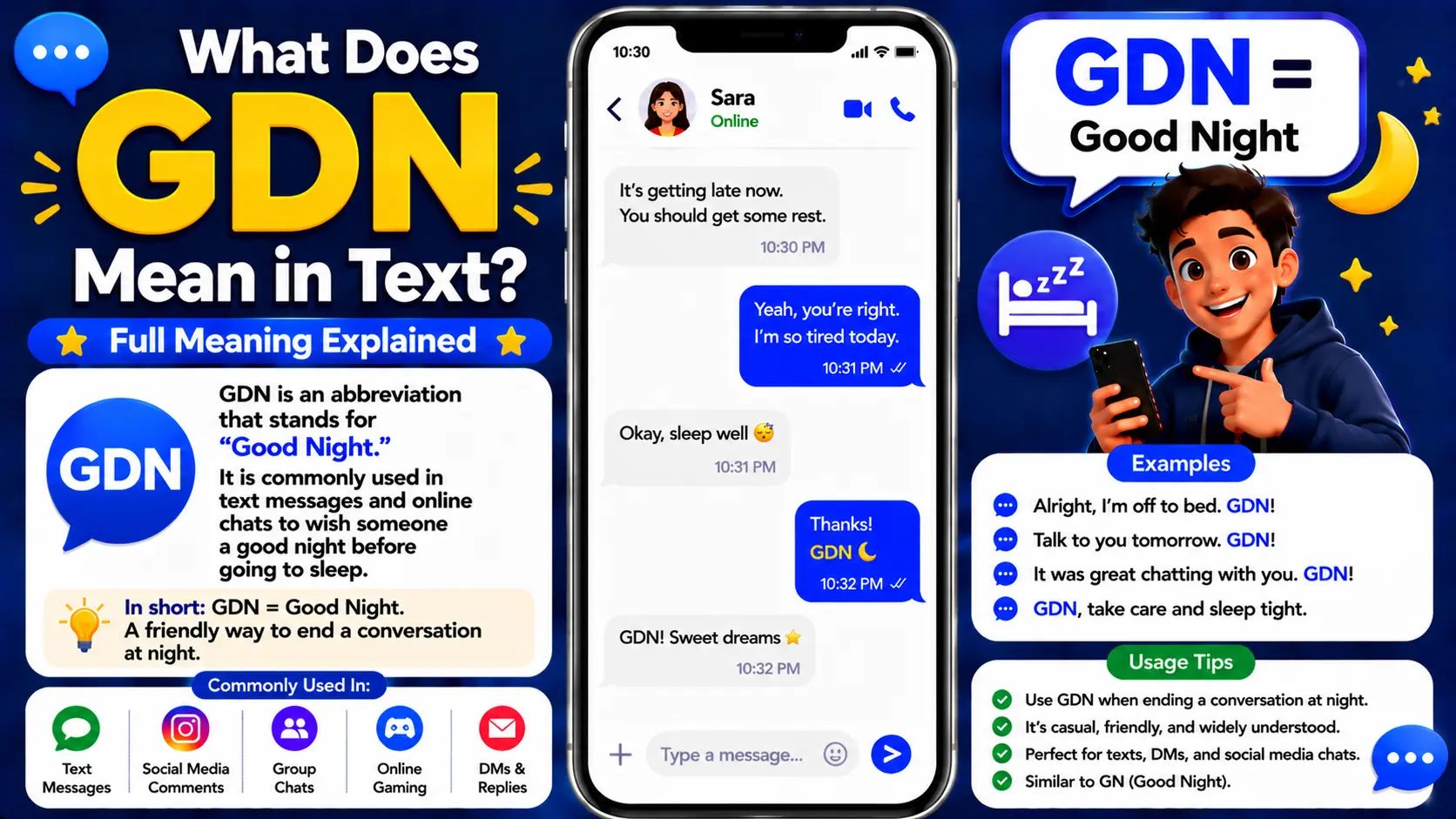
If you’ve recently seen “GDN” in a text message, TikTok comment, Snapchat streak, or Instagram DM, you’re probably wondering what it actually means. Like many internet abbreviations, GDN can feel confusing because its meaning changes depending on context, tone, and the relationship between the people talking.
Some people use it casually with friends. Others use it sarcastically, emotionally, or even flirtatiously. That’s exactly why so many users search for the phrase “what does GDN mean in text” after seeing it online.
The good news is that GDN is not complicated once you understand the context behind it. In modern texting culture, short abbreviations save time, add personality, and create emotional shorthand between people. GDN fits perfectly into that style of communication.
In this guide, you’ll learn:
- The actual meaning of GDN
- Where it came from
- How people use it in real conversations
- Emotional and cultural meanings behind it
- When you should and should not use it
By the end, you’ll understand GDN naturally instead of feeling lost every time it appears in a message.
GDN – Quick Meaning
In texting and online slang, GDN usually means “God Damn” or “Goddamn.”
People use it to express:
- Surprise
- Frustration
- Excitement
- Admiration
- Emotional intensity
It’s often written in lowercase or uppercase:
- gdn
- GDN
Simple Examples
“GDN that outfit looks amazing.”
“GDN I forgot my homework again.”
“This song is gdn addictive.”
The tone changes depending on the situation. Sometimes it sounds funny and dramatic. Other times it sounds emotional or annoyed.
Origin & Background
GDN comes from the longer phrase “God damn,” which has existed in English-speaking culture for centuries. Originally, the phrase had religious roots and was considered highly offensive in many communities.
Over time, especially through internet culture and texting, people shortened strong emotional expressions into abbreviations. Just like:
- OMG = Oh My God
- WTF = What The F***
- SMH = Shaking My Head
GDN became another quick emotional shortcut.
Social media platforms helped spread it rapidly:
- TikTok captions
- Snapchat chats
- Gaming communities
- Twitter/X replies
- Instagram comments
Young users especially began using shortened emotional slang because it feels faster, more expressive, and visually dramatic.
Today, GDN is less about religion and more about emotional emphasis.
For many users, it simply means:
- “Wow”
- “Seriously?”
- “That’s intense”
- “That’s impressive”
Its meaning evolved from a literal phrase into emotional internet language.
Real-Life Conversations
WhatsApp Conversation
Person A:
Did you see the final exam schedule?
Person B:
GDN they moved math to Monday 😭
Instagram DM
Person A:
Your vacation photos are outrageous.
Person B:
Haha thanks 😅
Person A:
No seriously, GDN that beach looks unreal.
TikTok Comments
Comment 1:
This transition is clean.
Comment 2:
GDN bro deserves more followers.
Text Message Conversation
Person A:
I accidentally sent the screenshot to my mom.
Person B:
GDN 💀 what happened after that?
These examples show how flexible the slang can be. It can express excitement, shock, humor, stress, admiration, or disbelief all at once.
Emotional & Psychological Meaning
One reason GDN became popular is because digital communication lacks facial expressions and vocal tone.
People use emotional slang to fill that gap.
When someone types “GDN,” they’re usually trying to intensify emotion quickly without writing a full sentence.
It often communicates:
- Emotional overload
- Genuine surprise
- Dramatic reaction
- Strong admiration
- Instant frustration
In many conversations, it also creates closeness between people. Shared slang feels informal and personal. It signals comfort and familiarity.
For example, imagine a friend texting you after getting rejected from a job interview:
“GDN I really thought I had it.”
That tiny abbreviation suddenly carries disappointment, frustration, and emotional exhaustion in a very human way.
Modern texting relies heavily on emotional compression. GDN works because people instantly recognize the emotional weight behind it.
Usage in Different Contexts
Social Media
On TikTok, Instagram, and Snapchat, GDN is often used dramatically for reactions.
Examples:
- “GDN this edit is fire.”
- “GDN you cooked with this one.”
- “That ending was GDN mistaken.”
It adds excitement and internet-style energy.
Friends & Relationships
Among friends, GDN usually feels casual and expressive.
Examples:
- “GDN you scared me.”
- “GDN I missed you.”
- “GDN that was embarrassing.”
In relationships, it can even sound playful or flirtatious:
- “GDN you look good tonight.”
Work or Professional Settings
Using GDN professionally is risky.
Even though it’s abbreviated, many people still recognize the original phrase. In workplaces, schools, or formal emails, it may appear immature or inappropriate.
Avoid using it with:
- Bosses
- Teachers
- Clients
- Professional networking contacts
Casual vs Serious Tone
GDN works best in casual conversation.
It can sound:
- Funny
- Emotional
- Sarcastic
- Supportive
- Dramatic
But in serious conversations involving grief, conflict, or sensitive topics, it may feel insensitive if used incorrectly.
Context matters more than the abbreviation itself.
When NOT to Use It
There are situations where GDN can create confusion or discomfort.
Formal Situations
Avoid it in:
- Job applications
- Academic writing
- Professional emails
- Business meetings
It reduces professionalism.
Religious or Conservative Audiences
Some people still consider “God damn” offensive because of its religious origin.
Using GDN around highly religious individuals may come across as disrespectful.
Serious Emotional Conversations
If someone shares deeply painful news, dramatic slang may seem careless.
For example:
- Family loss
- Mental health struggles
- Serious relationship issues
In those situations, clear and compassionate language works better.
Common Misunderstandings
People Think It Means Something Else
Some users assume GDN refers to:
- A gaming clan
- A company abbreviation
- A random username
- A hidden code
Context usually reveals the real meaning.
Tone Confusion
Because text lacks voice tone, GDN may sound:
- Aggressive
- Funny
- Excited
- Rude
The same word changes meaning depending on emojis, punctuation, and relationship dynamics.
Example:
- “GDN 😂” feels playful.
- “GDN.” feels annoyed.
Literal vs Figurative Meaning
Most users do not mean the phrase literally anymore.
Online slang often loses its original seriousness over time. For younger generations, GDN usually functions as emotional emphasis rather than a religious statement.
Comparison Table
| Expression | Meaning | Tone | Common Usage |
|---|---|---|---|
| GDN | God damn | Emotional/intense | Reactions |
| OMG | Oh my God | Surprise | Casual chats |
| WTF | What the f*** | Shock/confusion | Internet slang |
| SMH | Shaking my head | Disappointment | Social media |
| Dang | Mild frustration | Softer | Family-friendly |
| Sheesh | Amazement | Playful | Gen Z slang |
| Wow | Basic surprise | Neutral | Universal |
| BRUH | Disbelief | Funny/frustrated | Memes & texting |
Key Insight
GDN stands out because it mixes emotional intensity with casual internet culture. It feels stronger than “wow” but less aggressive than fully typing the original phrase.
Variations & Types of GDN
1. Gdnnn
Extra letters add dramatic emotion or excitement.
2. GDN 😭
Expresses emotional shock or frustration humorously.
3. GDN 💀
Used when something feels painfully funny or embarrassing.
4. Gahdamn
A stylized internet spelling for dramatic effect.
5. Goddamnnn
Extended spelling to intensify reaction.
6. GYAT Damn
Popular in TikTok humor culture when reacting to appearance.
7. DAAAMN
A softer alternative with similar emotional energy.
8. GDN bro
Adds friendliness or meme-style tone.
9. GDN fr
Means “seriously” or “for real.”
10. GDN that’s mistaken
Common reaction phrase in casual texting.
How to Respond When Someone Uses It
Casual Replies
- “Right??”
- “I know 😭”
- “mistaken honestly.”
- “That shocked me too.”
Funny Replies
- “Calm down drama queen 😂”
- “You survived though.”
- “Not the GDN reaction 💀”
- “Bro is emotionally damaged.”
Mature Replies
- “Yeah, that sounds frustrating.”
- “I can understand why you feel that way.”
- “That must’ve been intense.”
Respectful Replies
- “I hope things improve soon.”
- “I’m here if you need to talk.”
- “That sounds really difficult.”
Matching the emotional tone is more important than the exact words.
Regional & Cultural Usage
Western Culture
In the United States, Canada, and the UK, GDN is common in internet slang and casual texting. Younger generations use it frequently without much thought.
However, older users may still find it offensive.
Asian Culture
In many Asian countries, English slang is often adopted through TikTok, gaming, and K-pop fandom spaces.
Some users know GDN only as trendy internet language and may not fully connect it to its original religious meaning.
Middle Eastern Culture
In conservative communities, phrases involving religious references can be more sensitive.
Because of this, some users avoid GDN entirely in public conversations or family settings.
Global Internet Usage
Online culture blends language rapidly. GDN now appears in:
- Gaming chats
- Meme culture
- Reaction videos
- Fan communities
- Streaming platforms
Its emotional tone is understood globally even by non-native English speakers.
Gen Z vs Millennials
Gen Z
- Uses GDN more casually
- Often pairs it with emojis
- Treats it as reaction slang
Millennials
- More aware of the phrase’s original impact
- May use it less frequently
- Often interpret tone more seriously
Generational communication styles shape how slang evolves.
Is It Safe for Kids?
GDN is considered mild internet slang by many teenagers, but parents and educators may still view it as inappropriate because it comes from a curse phrase.
It is not among the harshest forms of online slang, but context matters.
For younger kids:
- Better avoided in school settings
- Not ideal for formal communication
- Should be understood before being repeated casually
Teaching context awareness is more useful than simply banning slang altogether.
FAQs
What does GDN stand for in text?
GDN usually stands for “God damn” and is used to express strong emotion like surprise, frustration, or admiration.
Is GDN offensive?
It depends on the audience. Some people see it as harmless slang, while others consider it disrespectful due to religious origins.
Is GDN popular on TikTok?
Yes. GDN appears frequently in TikTok comments, captions, and reaction videos.
Can I use GDN professionally?
It’s best not to. Even abbreviated slang can appear unprofessional in workplace or academic settings.
Does GDN always mean anger?
No. It can also express excitement, amazement, humor, or emotional shock.
What’s the difference between GDN and OMG?
OMG is lighter and more universal. GDN usually carries stronger emotional intensity.
Why do people shorten phrases like this?
Shortened slang makes texting faster while still expressing emotion and personality.
Conclusion
Understanding what GDN means in text is really about understanding modern digital emotion.
People no longer communicate online using only full sentences and formal grammar. Instead, they use abbreviations, emojis, slang, and reactions to express feelings quickly and naturally. GDN became popular because it captures strong emotion in just three letters.
Depending on context, it can mean surprise, admiration, frustration, excitement, or disbelief. That flexibility is exactly why it appears everywhere from TikTok comments to late-night group chats.
Still, context always matters. What feels funny among friends may sound disrespectful in professional or sensitive situations. The smartest communicators understand not only what slang means, but when it fits the moment.
Now when you see “GDN” in a message, you’ll recognize the emotional tone behind it instead of feeling confused. And if you decide to use it yourself, you’ll know exactly how to use it naturally and confidently.