
If you have ever seen someone reply with “ROF” in a chat and paused for a second, you are not alone. Texting slang evolves quickly, and even small abbreviations can leave people confused.
So, what does ROF mean in text?
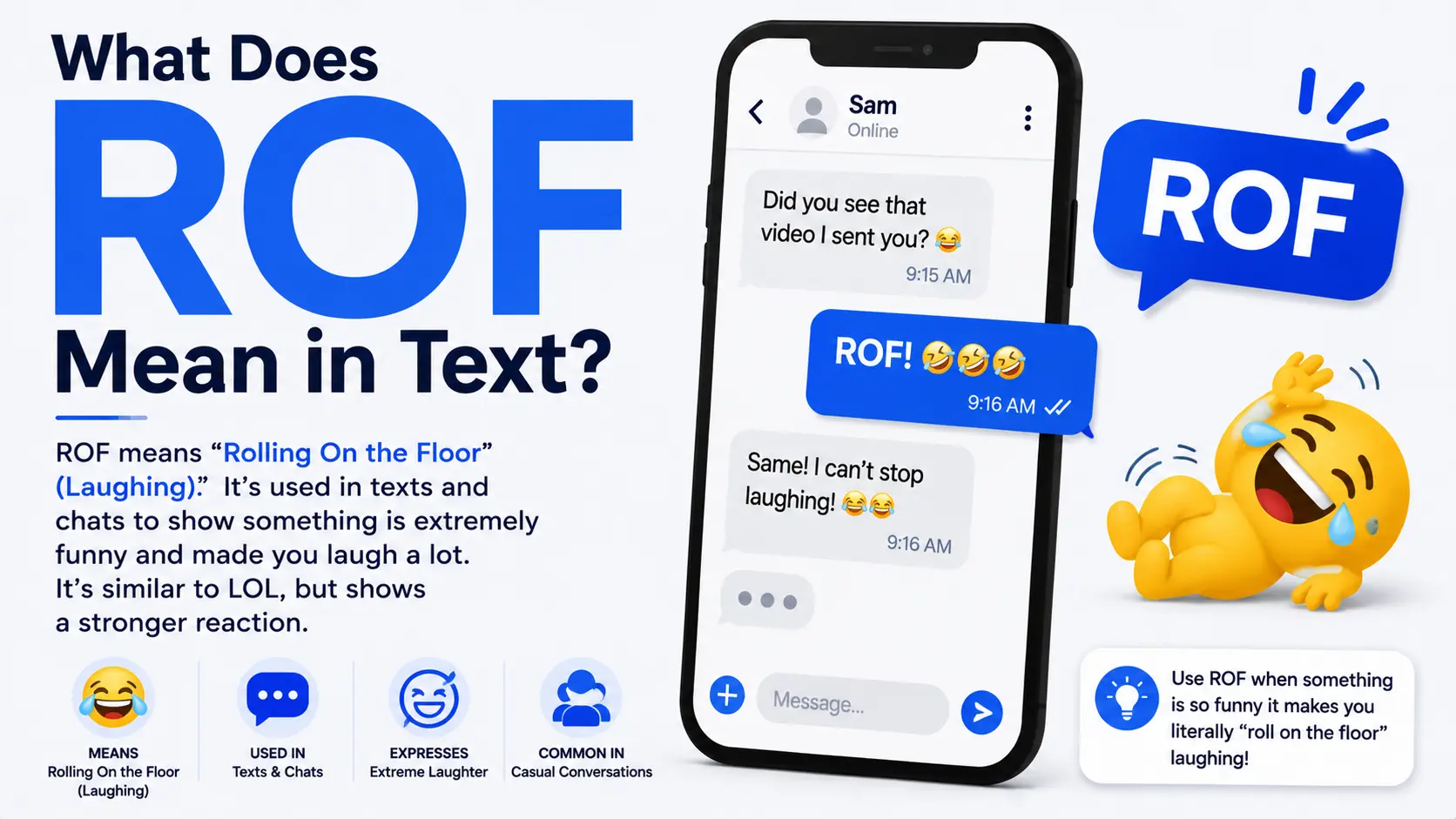
In most online conversations, ROF is used as a shortened version of “roll on floor,” usually implying laughter or extreme amusement. It is closely related to the more popular “ROFL” which stands for “roll on floor laughing.”
People use ROF to react quickly in casual chats when something is funny, surprising, or absurd. It saves time, keeps the tone light, and fits perfectly into fast digital conversations on apps like WhatsApp, Instagram, TikTok, and Snapchat.
This guide breaks down everything you need to know about ROF, including its meaning, origin, real-life usage, emotional tone, and how to respond when someone sends it.
ROF – Quick Meaning
ROF generally stands for:
- Roll On Floor (laughing or reacting humorously)
- A shortened or incomplete version of ROFL
- A casual reaction to something funny or shocking
Simple examples:
- “That joke was so funny ROF”
- “I just saw your video ROF”
- “ROF I cannot stop laughing”
In most cases, ROF is used informally and is not a formal acronym.
Origin & Background
The origin of ROF is closely tied to early internet slang culture.
During the early days of chat rooms and instant messaging platforms like MSN Messenger, Yahoo Chat, and early forums, users developed shortcuts to express emotions quickly. This led to popular acronyms like LOL, ROFL, BRB, and OMG.
ROFL (roll on floor laughing) became widely used first. Over time, people began shortening it further for faster typing, especially on mobile phones where typing speed mattered.
ROF emerged as an even shorter variant, though it is less standardized. It is often used by younger users or in casual texting environments where spelling consistency is not a concern.
Social media platforms like Twitter, TikTok comments, and Instagram DMs helped spread ROF, especially among Gen Z users who prefer quick and expressive shorthand.
Real-Life Conversations
Here are some realistic examples of how ROF appears in everyday chats.
WhatsApp Conversation
Person A:
I just sent my mom a meme and she forwarded it back to me 😂
Person B:
ROF that is so typical
Instagram DM
Person A:
Did you see my dance video?
Person B:
Yes ROF I cannot unsee it 😂
TikTok Comment Section
User 1:
This video is too accurate
User 2:
ROF this is literally my life
Text Message
Friend A:
I tripped in front of everyone today
Friend B:
ROF are you okay though?
These examples show that ROF is mostly used in humorous or lighthearted contexts, often replacing laughter or emojis.
Emotional & Psychological Meaning
ROF is not just a random abbreviation. It reflects how people emotionally react in digital conversations.
When someone uses ROF, they are usually expressing:
- Amusement or laughter
- Shock mixed with humor
- A relaxed, informal tone
- Social bonding through shared jokes
In modern communication, people prefer short emotional signals instead of long sentences. ROF works as a quick emotional shortcut.
A simple scenario
Imagine you are chatting with a friend who tells you they accidentally sent a voice note meant for their crush to their teacher. Instead of writing “that is so funny I cannot stop laughing,” you simply reply “ROF.”
It instantly conveys your reaction without slowing down the conversation.
Psychologically, this shows how digital communication prioritizes speed and emotional clarity over grammar or formality.
Usage in Different Contexts
1. Social Media
ROF is commonly used in comments, captions, and replies on platforms like Instagram, TikTok, and X (Twitter). It expresses quick reactions to funny posts.
Example:
“That plot twist was ridiculous ROF”
2. Friends and Relationships
Among friends, ROF is used to react to jokes, embarrassing stories, or memes.
Example:
“You sent that message to your ex? ROF”
3. Work or Professional Settings
ROF is generally not appropriate in formal communication. However, in very casual workplace chats among close colleagues, it might appear.
Example (informal team chat):
“Forgot the meeting link again ROF”
Still, it should be avoided in emails or official communication.
4. Casual vs Serious Tone
- Casual tone: Common and acceptable
- Serious tone: Not suitable
- Professional tone: Avoid using
ROF is strongly tied to informal digital culture.
When NOT to Use It
Even though ROF is fun and expressive, there are situations where it should not be used:
- Formal emails or business communication
- Academic writing or essays
- Sensitive conversations involving serious topics
- Messages where tone might be misunderstood
For example, if someone shares bad news, responding with ROF would be inappropriate and could seem disrespectful.
Common Misunderstandings
Many people confuse ROF with similar slang or misinterpret its tone.
1. Thinking it is ROFL
Most people assume ROF is just a typo of ROFL, and in many cases, that is true.
2. Assuming it is aggressive or sarcastic
Depending on context, ROF might seem sarcastic, but usually it is playful.
3. Overusing it
Some users repeat ROF too often, which can reduce its impact and make conversations feel unnatural.
4. Misreading seriousness
Without emojis or context, ROF can sometimes be misinterpreted as mocking.
Comparison Table
| Term | Meaning | Usage | Emotion |
|---|---|---|---|
| ROF | Roll on floor | Casual texting | Humor, laughter |
| ROFL | Roll on floor laughing | Stronger version of ROF | Strong laughter |
| LOL | Laugh out loud | General laughter | Light amusement |
| LMAO | Laughing my a off | Very strong humor | Intense laughter |
| XD | Facial expression | Informal reaction | Playful tone |
| Haha | Simple laugh | Universal use | Mild amusement |
| ROFLOL | Combination slang | Rare usage | Extreme laughter |
| Hehe | Soft laugh | Friendly tone | Shy or playful |
Key Insight
ROF sits in the middle of internet laughter slang. It is less intense than ROFL but still clearly expresses humor in a fast and casual way.
Variations / Types of ROF
Here are common variations and related expressions:
- ROF – Simple version of roll on floor
- ROFL – Roll on floor laughing, more popular
- ROFLMAO – Extremely exaggerated laughter
- ROFLOL – Combined humorous slang
- ROF 😂 – ROF with emoji for clarity
- ROF I am dead – Hyperbolic expression of laughter
- ROF so funny – Extended reaction
- ROF no way – Surprise and humor combined
- ROF stop it – Reaction to repeated jokes
- ROF I cannot – Incomplete emotional reaction
Each variation adjusts emotional intensity depending on context.
How to Respond When Someone Uses It
Casual replies
- “I know right 😂”
- “That was hilarious”
- “Same here”
Funny replies
- “ROF we are losing it”
- “Glad I made you laugh”
- “Wait till you hear the next one”
Mature replies
- “That was unexpected but funny”
- “I understand why that is amusing”
Respectful replies
- “Haha I am glad you found it funny”
- “Nice to know it made you laugh”
Your response should match the tone of the conversation.
Regional & Cultural Usage
Western culture
ROF is mostly used in informal online chats, especially among teens and young adults.
Asian culture
Widely adopted in messaging apps, often mixed with emojis for clarity.
Middle Eastern culture
Used in casual digital communication but less common in formal settings.
Global internet usage
ROF is recognized globally but not as common as LOL or ROFL.
Generational differences
- Gen Z: Frequently uses ROF in memes and chats
- Millennials: Prefer LOL or ROFL
- Older generations: May not recognize ROF at all
Is It Safe for Kids?
Yes, ROF is generally safe for kids because it is simply a slang expression for laughter.
However, context matters. Parents and educators should ensure children understand when slang is appropriate and when formal language is required.
FAQs
1. What does ROF mean in texting?
It means “roll on floor,” usually expressing laughter or amusement.
2. Is ROF the same as ROFL?
Yes, ROF is a shorter or less common version of ROFL.
3. Is ROF formal or informal?
It is strictly informal and used in casual conversations.
4. Can ROF be used in professional messages?
No, it should be avoided in professional or formal communication.
5. Why do people use ROF instead of LOL?
Some people prefer it for stronger emotional expression or faster typing.
6. Is ROF still popular today?
It is used, but ROFL and emojis are more common.
7. Does ROF always mean laughter?
Mostly yes, but meaning depends on context.
Conclusion
Understanding what ROF means in text helps you stay confident in modern digital communication. It is a simple slang term that reflects humor, reaction, and emotional expression in fast-paced online conversations.
While it may seem small, ROF is part of a larger internet language that continues to evolve with how people communicate.
Using it naturally can make your chats feel more relaxed and expressive, but knowing when to avoid it is just as important.
In the end, ROF is not just an abbreviation. It is a snapshot of how language adapts to emotion, speed, and digital culture.