
If you’ve ever reread a message and thought, “Wait… was that rude or just normal?” you’re not alone.
Understanding tone in text has become one of the biggest challenges in modern communication. Without facial expressions, voice, or body language, even a simple “okay” can feel confusing or even cold.
People search for “what does tone mean in text” because they want clarity. They want to avoid misunderstandings, awkward replies, and unnecessary overthinking.
This guide breaks it down in a natural, real-life way so you can not only understand tone but also use it confidently in your own messages.
What Does Tone Mean in Text – Quick Meaning
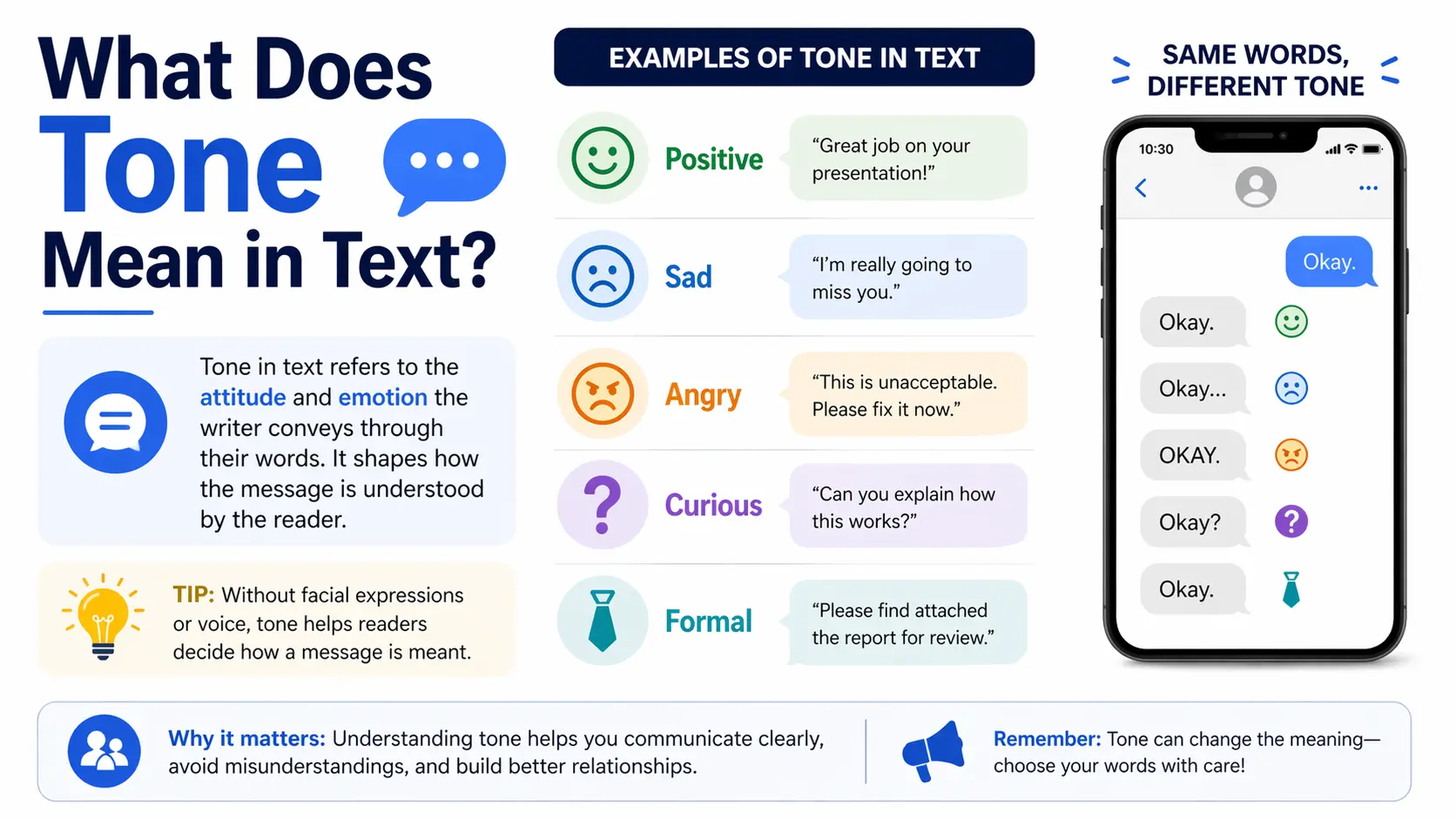
Tone in text refers to the emotional feeling or attitude behind a message.
It’s not just what you say, but how it feels when someone reads it.
Simple definition:
- Tone = the emotion or attitude behind written words
- It shapes how your message is interpreted
- It can completely change meaning, even with the same words
Examples:
- “Fine.” → could feel annoyed or dismissive
- “Fine 😊” → feels calm or reassuring
- “Fine!!!” → sounds excited or intense
Tone is invisible but powerful. It lives between the lines.
Origin & Background
Tone itself isn’t new. It comes from spoken language, where voice pitch, rhythm, and expression naturally carry emotion.
In traditional communication:
- A raised voice shows anger
- A soft voice shows care
- A pause can signal hesitation
But with texting, all of that disappeared.
When texting became popular through SMS and later apps like WhatsApp and Instagram, people had to recreate tone manually. That’s how we got:
- Emojis
- Punctuation styles
- Slang and abbreviations
Social media made tone even more layered. Platforms like TikTok and Instagram introduced irony, sarcasm, and humor that often rely on shared cultural understanding.
Over time, tone in text evolved into a skill. Not just something you use, but something you learn to read.
Real-Life Conversations
Here’s how tone plays out in everyday digital conversations.
1. WhatsApp Chat
Person A: Did you finish the work?
Person B: Yeah
This feels neutral or slightly cold.
Person B: Yeah, just sent it 👍
Now it feels cooperative and positive.
2. Instagram DM
Person A: You ignored me yesterday
Person B: I was busy
This can feel defensive.
Person B: I was busy 😅 sorry, I’ll call you later
Now it feels apologetic and warm.
3. TikTok Comments
Comment: Wow, that was something
This could mean:
- impressed
- confused
- sarcastic
Tone depends on context and emojis.
Comment: Wow, that was something 😂
Now it clearly feels humorous.
4. Text Message
Person A: I guess you don’t care
Person B: That’s not true
Sounds serious and tense.
Person B: That’s not true at all, you know I do ❤️
Now it feels emotional and reassuring.
Emotional & Psychological Meaning
Tone in text reveals more than words. It shows intention, mood, and even personality.
People use tone to:
- Express emotions indirectly
- Protect themselves from vulnerability
- Add humor or sarcasm
- Avoid conflict
Psychologically, humans are wired to interpret emotion, even when it’s not obvious. That’s why we sometimes overthink texts.
A relatable scenario:
You send: “Okay.”
You meant: “I understand.”
But the other person reads it as: “I’m annoyed.”
This gap between intention and interpretation is where tone becomes crucial.
Tone is not just communication. It’s perception.
Usage in Different Contexts
1. Social Media
Tone is often playful, sarcastic, or exaggerated.
People use:
- Emojis
- Slang
- Dramatic punctuation
Example: “I’m literally dying 😂”
It doesn’t mean sadness. It means something is very funny.
2. Friends & Relationships
Tone becomes more emotional and personal.
- Short replies can feel distant
- Long, expressive messages feel caring
Example:
“I’m fine” vs “I’m fine, don’t worry about me ❤️”
Same words. Completely different tone.
3. Work / Professional Settings
Tone should be clear, respectful, and neutral.
Avoid:
- Overusing emojis
- Being too blunt
Better:
“Could you please review this when you have time?”
4. Casual vs Serious Tone
- Casual tone = relaxed, friendly, sometimes playful
- Serious tone = direct, focused, emotionally neutral
Knowing when to switch is key to effective communication.
When NOT to Use Certain Tones
Tone can easily be misunderstood in the wrong context.
Avoid unclear or risky tone when:
- Discussing serious topics
- Talking to someone you don’t know well
- Communicating professionally
- Addressing conflict
For example, sarcasm in text often backfires because there’s no voice to support it.
Also be mindful of cultural differences. What feels normal to you may feel rude to someone else.
Common Misunderstandings
Tone confusion happens all the time.
What people get wrong:
- Assuming short replies mean anger
- Misreading sarcasm as seriousness
- Thinking emojis always soften tone
Literal vs emotional meaning:
Text: “Do whatever you want”
Literal meaning: freedom
Emotional tone: frustration or giving up
Understanding tone means looking beyond words.
Comparison Table
| Expression Type | Meaning | Tone Feel |
|---|---|---|
| “Okay” | Neutral agreement | Cold or distant |
| “Okay 🙂” | Friendly agreement | Warm and polite |
| “Sure.” | Agreement | Slightly formal |
| “Sure!!” | Excited agreement | Enthusiastic |
| “Whatever” | Indifference | Dismissive |
| “No worries” | Reassurance | Relaxed and kind |
| “Fine.” | Acceptance | Possibly annoyed |
| “Got it 👍” | Confirmation | Positive and clear |
Key Insight
Tone is not fixed. It shifts based on context, punctuation, and relationship. The same word can feel supportive or hurtful depending on how it’s delivered.
Variations / Types of Tone in Text
Here are common tone types you’ll see daily:
- Friendly tone
Warm and approachable
“Hey! How are you 😊” - Sarcastic tone
Opposite meaning, often humorous
“Great… just great 🙃” - Passive-aggressive tone
Indirect frustration
“Do whatever you think is best” - Formal tone
Professional and respectful
“Please let me know your availability” - Playful tone
Light and teasing
“Wow, look who finally replied 😄” - Romantic tone
Affectionate and emotional
“Miss you already ❤️” - Angry tone
Direct and intense
“This is not okay” - Dry tone
Minimal emotion
“Okay” - Excited tone
High energy
“I can’t wait!!!” - Apologetic tone
Soft and regretful
“I’m really sorry about that”
How to Respond When Someone Uses Tone
Casual Replies
- “Got you 👍”
- “Makes sense”
Funny Replies
- “Wow, dramatic much 😂”
- “I felt that through the screen”
Mature Replies
- “I understand what you mean”
- “Let’s talk it out clearly”
Respectful Replies
- “Thanks for explaining”
- “I appreciate your message”
Your response tone matters just as much as theirs.
Regional & Cultural Usage
Western Culture
Tone is often expressive and emoji-heavy. Sarcasm is common.
Asian Culture
Tone tends to be more polite and indirect. Respect plays a big role.
Middle Eastern Culture
Communication can be warm and expressive, but respect and hierarchy matter.
Global Internet Usage
Tone blends across cultures. Memes and trends shape how tone is used.
Generational Differences
- Gen Z: Uses irony, humor, and layered tone
- Millennials: Balanced tone with emojis and clarity
Understanding these differences helps avoid misinterpretation.
Is It Safe for Kids?
Yes, but with awareness.
Kids often struggle with tone because it requires emotional understanding. Without guidance, they may misinterpret messages or unintentionally sound rude.
Teaching them:
- How tone works
- How to use emojis wisely
- How to read context
can improve their communication skills early.
FAQs
1. What does tone mean in texting?
It’s the emotional feeling or attitude behind a message.
2. Why is tone important in text?
Because it affects how your message is understood without voice or facial cues.
3. Can tone change meaning?
Yes, completely. The same words can feel kind or rude depending on tone.
4. How do you show tone in text?
Through punctuation, emojis, word choice, and sentence structure.
5. Why do texts get misunderstood?
Because tone is not visible and depends on interpretation.
6. Are emojis necessary for tone?
Not always, but they help clarify emotion.
7. What is a neutral tone?
A tone that is clear, direct, and emotionally balanced.
Conclusion
Tone in text is one of the most powerful yet misunderstood parts of modern communication.
It shapes how your words are felt, not just read.
Once you become aware of tone, everything changes. You stop overthinking every message, and you start expressing yourself more clearly.
The key is simple:
Be intentional, be aware, and when in doubt, add a little warmth.
Because sometimes, one emoji or one extra word can turn confusion into connection.