
In texting, even the smallest words can carry big emotional meaning. One of the most common examples is “um.” You’ve probably seen it in messages like:
“Um… what just happened?”
“Um, are you serious right now?”
“I mean… um… maybe.”
At first glance, it looks simple. But depending on the situation, “um” can express hesitation, awkwardness, confusion, sarcasm, shock, or even emotional vulnerability.
People search for “what does um mean in text” because the tone behind it is not always obvious. Sometimes it sounds playful. Other times it feels tense or uncomfortable. In digital communication, where facial expressions and voice tone disappear, small filler words suddenly become powerful emotional signals.
This guide explains what “um” really means in texting, how people use it online, and why it has become such a huge part of modern conversations.
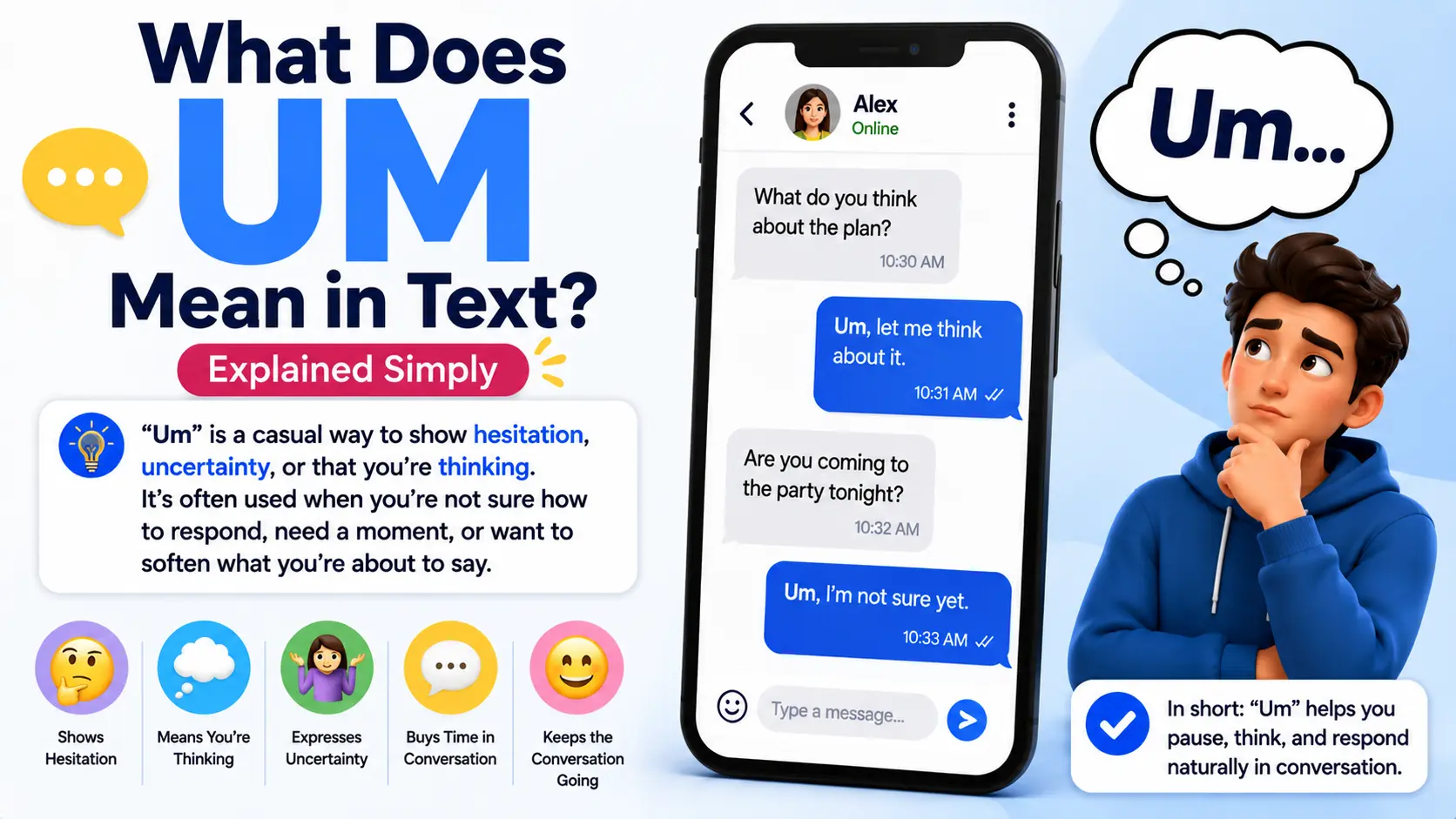
Um Meaning in Text – Quick Definition
“Um” is a filler word people use when they are:
- Thinking
- Hesitating
- Feeling awkward
- Unsure what to say
- Reacting emotionally
- Buying time before responding
In text messages, “um” often shows emotion more than actual meaning.
Simple Examples
“Um… I don’t think that’s a good idea.”
“Um excuse me???”
“Umm maybe later.”
The number of letters and punctuation can change the tone:
- Um = neutral hesitation
- Umm = softer or playful
- Ummm = disbelief, awkwardness, or suspicion
- UM = dramatic shock or anger
Origin & Background of “Um”
“Um” did not begin with texting. It has existed in spoken English for centuries as a natural pause word.
People use filler sounds like:
- Um
- Uh
- Er
- Hmm
These sounds help the brain process thoughts during conversation.
Before smartphones, “um” mostly existed in speech. But texting and social media transformed it into a written emotional cue.
Today, “um” appears everywhere:
- TikTok captions
- Instagram comments
- WhatsApp chats
- YouTube reactions
- Meme culture
The internet turned ordinary speech habits into personality markers.
For example, typing:
“Um no.”
feels completely different from:
“No.”
The first feels emotional, expressive, and human. The second feels cold and direct.
That shift is part of how digital culture changed communication.
Real-Life Conversations Using “Um”
WhatsApp Conversation
Person A:
Did you tell everyone about my secret?
Person B:
Um… no?
Person A:
Why does that sound suspicious 😭
Here, “um” suggests nervousness or guilt.
Instagram DM
Person A:
You liked your ex’s picture?
Person B:
Umm it was an accident.
Person A:
Sure it was 💀
In this case, “umm” signals defensiveness and awkwardness.
TikTok Comments
Commenter 1:
This outfit is giving 2016 energy.
Commenter 2:
UM that’s literally the point.
Here, “UM” adds dramatic emphasis and mild attitude.
Text Message Conversation
Person A:
I think I accidentally sent the email to the wrong person.
Person B:
Um WHAT???
This version expresses immediate shock.
Emotional & Psychological Meaning of “Um”
“Um” may seem meaningless, but psychologically it reveals a lot about human emotion.
People use it when they need a small emotional buffer before speaking honestly.
It can signal:
- Anxiety
- Embarrassment
- Uncertainty
- Carefulness
- Disbelief
- Social discomfort
In texting, “um” softens communication. It creates a pause that mimics real-life speech.
Without it, messages can sound robotic or harsh.
For example:
“That was rude.”
feels more aggressive than:
“Um… that was kind of rude.”
The second version sounds emotionally aware and less confrontational.
A Real-Life Style Scenario
Imagine a friend suddenly cancels plans for the third time.
You type:
“Um okay…”
That tiny word carries disappointment, confusion, and frustration without directly saying all of it.
That’s why “um” matters so much online. It acts like emotional punctuation.
Usage in Different Contexts
Social Media
On social platforms, “um” often adds humor, sarcasm, or dramatic reaction.
Examples:
“Um this is actually iconic.”
“Ummm why is nobody talking about this?”
It helps creators sound casual and emotionally expressive.
Friends & Relationships
Among friends, “um” can be playful or awkward depending on tone.
Examples:
“Um bestie… what are you doing?”
“Um I miss you.”
In relationships, it often appears during emotionally sensitive conversations.
Work & Professional Settings
Using “um” professionally depends on context.
Casual workplace chats may allow it:
“Um, I think there’s a small issue with the file.”
But in formal emails or presentations, excessive “um” may appear unconfident.
Professional communication usually benefits from clarity and directness.
Casual vs Serious Tone
Casual
“Umm okay lol.”
Lighthearted and relaxed.
Serious
“Um, we need to talk.”
More emotionally loaded and tense.
Context changes everything.
When NOT to Use “Um”
Although common, “um” is not always appropriate.
Formal Communication
Avoid it in:
- Job applications
- Academic papers
- Professional reports
- Legal communication
It may sound uncertain or unprepared.
Sensitive Conversations
In emotional situations, “um” can accidentally seem dismissive.
For example:
“Um sorry for your loss.”
may feel emotionally detached.
A direct and sincere response works better.
Cross-Cultural Communication
Some cultures interpret hesitation differently.
Too many filler words may sound:
- Nervous
- Passive
- Disrespectful
- Unclear
Tone awareness matters.
Common Misunderstandings About “Um”
People Think It Always Means Confusion
Not true.
Sometimes “um” simply adds emotional texture.
It Can Sound Rude Online
Short replies like:
“Um no.”
can appear sarcastic or defensive.
Without voice tone, readers often assume attitude.
More Letters Change the Emotion
- “Um” = mild hesitation
- “Ummm” = suspicion or disbelief
- “UMMM???” = dramatic reaction
Tiny spelling changes affect interpretation.
Silence vs “Um”
Sometimes people use “um” to avoid seeming cold.
Compare:
“No.”
vs
“Um… no.”
The second feels softer and more human.
Comparison Table
| Expression | Meaning | Tone |
|---|---|---|
| Um | Hesitation or emotional pause | Neutral |
| Uh | Casual thinking pause | Relaxed |
| Hmm | Deep thinking or skepticism | Reflective |
| Like | Conversational filler | Informal |
| Well | Soft transition response | Polite |
| Nope | Direct refusal | Casual |
| Obviously | Strong certainty | Confident |
| Seriously? | Shock or disbelief | Emotional |
Key Insight
“Um” stands out because it blends thought and emotion together. It is not just a filler word. It often reveals how comfortable, nervous, surprised, or emotionally careful someone feels in the moment.
Variations & Types of “Um”
1. Um
Basic hesitation or pause.
2. Umm
Softer and more conversational.
3. Ummm
Disbelief or suspicion.
4. Umm…
Awkward or emotionally uncertain.
5. UM
Strong emotional emphasis.
6. Um okay
Passive disappointment or confusion.
7. Um no
Polite disagreement or sarcasm.
8. Um excuse me?
Offended surprise.
9. Um hello?
Trying to get attention or express disbelief.
10. Um what?
Confused reaction.
How to Respond When Someone Uses “Um”
Casual Replies
- “Haha what?”
- “Go on 👀”
- “Why the hesitation?”
Funny Replies
- “That ‘um’ sounds dangerous.”
- “You typed ‘um’ like you saw a ghost.”
- “Now I’m nervous 😭”
Mature Replies
- “Take your time.”
- “I understand what you mean.”
- “Tell me honestly.”
Respectful Replies
- “Could you explain a little more?”
- “I’m listening.”
- “No pressure.”
Your response should match the emotional tone behind the “um.”
Regional & Cultural Usage
Western Culture
In Western texting culture, “um” is extremely common and usually harmless.
It often adds personality and emotional realism.
Asian Culture
In some Asian communication styles, hesitation words may reflect politeness and careful speech.
Using “um” can soften disagreement.
Middle Eastern Culture
Tone and respect matter heavily in communication.
Too much hesitation may sometimes seem uncertain, but softer wording is often appreciated in personal conversations.
Global Internet Usage
Online culture made “um” universal.
Even non-native English speakers use it because social media normalized conversational English patterns worldwide.
Gen Z vs Millennials
Gen Z
Gen Z often uses “um” dramatically or sarcastically.
Example:
“UM THAT’S INSANE.”
It becomes part of meme culture and emotional exaggeration.
Millennials
Millennials tend to use it more naturally as conversational filler.
Example:
“Um yeah, that was awkward.”
The tone is usually calmer and more realistic.
Is “Um” Safe for Kids?
Yes, “um” is generally safe for kids.
It is not offensive or inappropriate.
However, context still matters. Kids may copy sarcastic or dramatic internet tones without understanding emotional nuance.
Parents and educators can help children understand how tone changes meaning in digital communication.
Frequently Asked Questions
What does “um” mean in texting?
It usually expresses hesitation, awkwardness, confusion, or emotional reaction before a statement.
Is “um” rude?
Not always. Tone and context determine whether it sounds playful, awkward, sarcastic, or disrespectful.
Why do people type “ummm”?
Extra letters usually add stronger emotion like disbelief, suspicion, or dramatic reaction.
What’s the difference between “um” and “uh”?
“Um” often sounds more thoughtful or emotional, while “uh” feels casual and spontaneous.
Does “um” mean someone is lying?
Not necessarily. It can suggest nervousness, but many honest people use filler words naturally.
Why is “um” so common online?
It helps text feel more human, emotional, and conversational in digital communication.
Can “um” be flirtatious?
Sometimes, yes. In certain conversations, hesitation can create playful tension or shyness.
Conclusion
“Um” may look tiny, but it carries surprisingly deep emotional meaning in text conversations.
It can express hesitation, sarcasm, awkwardness, curiosity, vulnerability, or disbelief depending on the situation. In modern communication, people use it to recreate the pauses and emotions of real speech.
That is why understanding “um” matters more than many people realize.
The next time someone texts:
“Um…”
pay attention to the context, punctuation, and emotional tone around it. Often, that little word says much more than the rest of the sentence.
And once you understand how it works, you can use it confidently without misunderstanding the emotion behind it.