
If you’ve recently seen “FNF” in a message and paused for a second, you’re not alone. It’s one of those short forms that looks simple but can carry very different meanings depending on the context.
People search for what fnf mean in text because it pops up everywhere. You might see it in a casual chat, a social media caption, or even in a slightly serious conversation. Without context, it can feel confusing or even misleading.
This article clears that confusion. You’ll learn not just the definition, but how people actually use it, what emotions sit behind it, and when it might be misunderstood.
FNF – Quick Meaning
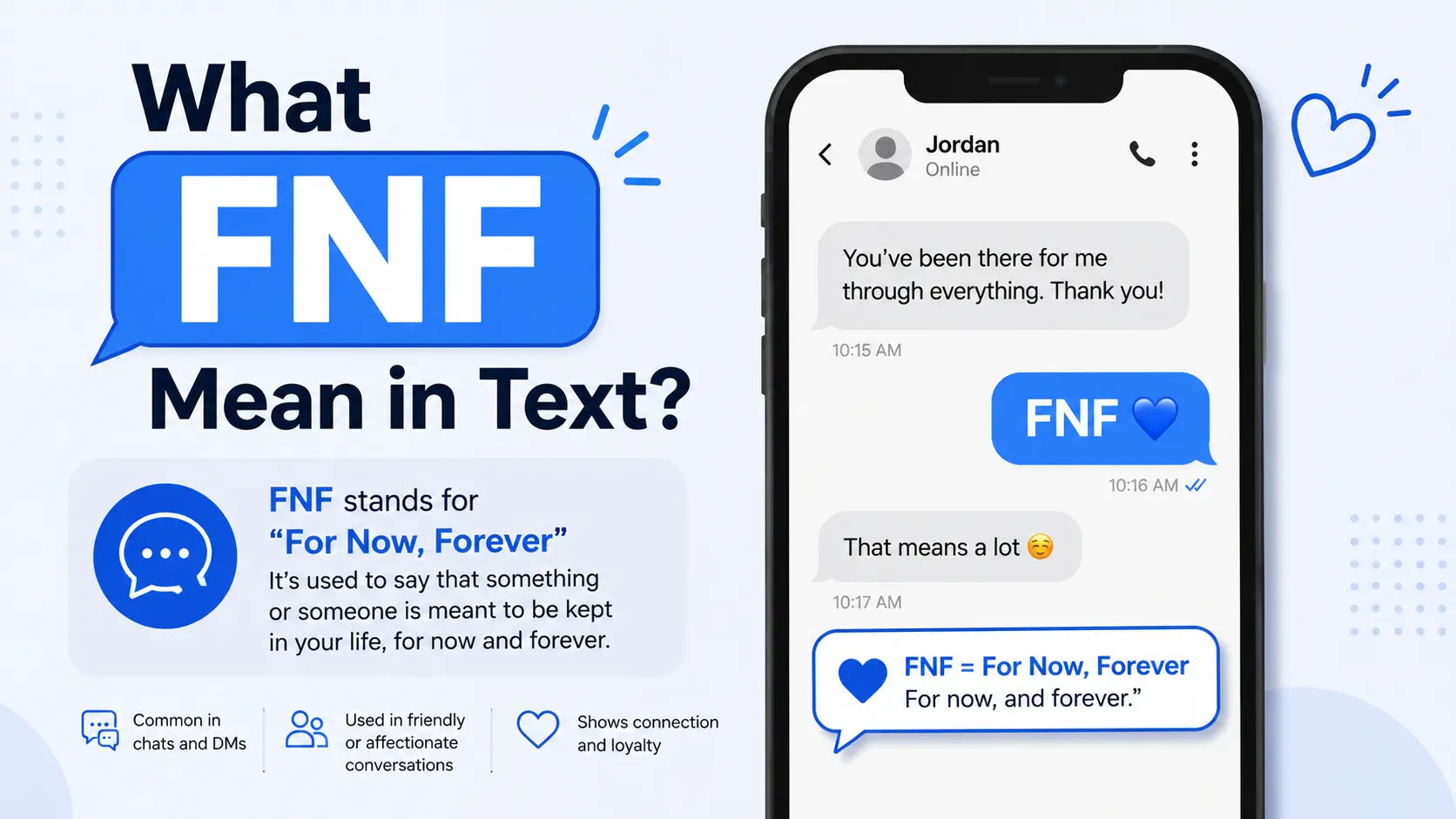
In texting, FNF most commonly means “Friends and Family.”
It can also have other meanings depending on the situation, but this is the most widely used one.
Simple definition:
- FNF = Friends and Family
- Used to refer to close, trusted people
- Often implies comfort, trust, or priority
Example messages:
- “This party is just FNF, no outsiders.”
- “I only share this with FNF.”
- “It’s an FNF discount, don’t tell others.”
Origin & Background
The term “FNF” didn’t start as internet slang. It actually comes from everyday language where “friends and family” has always been a natural phrase.
Over time, digital communication shortened it.
Social media platforms and messaging apps played a big role. As conversations became faster and more informal, abbreviations like FNF became popular.
It also gained traction in specific areas:
- Online payments where “FNF transfers” mean trusted transactions
- Gaming communities
- Private social circles online
Interestingly, the meaning stayed mostly stable. Unlike many slang terms that evolve wildly, FNF kept its core idea of closeness and trust.
Real-Life Conversations
WhatsApp Chat
Person A: Are you inviting everyone?
Person B: Nah, just FNF this time.
Instagram DMs
Person A: Why didn’t you post the full video?
Person B: That part is only for FNF 😅
TikTok Comments
Person A: Drop the link!
Person B: It’s FNF only, sorry!
Text Message
Person A: Can I bring a friend?
Person B: Keeping it FNF tonight, hope you understand.
These examples show how FNF naturally fits into real conversations without sounding forced.
Emotional & Psychological Meaning
FNF is more than just a label. It carries emotional weight.
When someone uses FNF, they are usually expressing:
- Trust
- Exclusivity
- Comfort
- Boundaries
It draws a line between “inner circle” and “everyone else.”
Why people use it
People want to protect their space. In a world where everything is public, FNF creates a sense of privacy.
A relatable scenario
Imagine someone sharing a personal photo but saying, “Only FNF can see this.”
It signals vulnerability and trust. They are choosing safety over exposure.
That small abbreviation quietly communicates a lot about emotional closeness.
Usage in Different Contexts
Social Media
FNF is often used to limit access:
- Private stories
- Exclusive content
- Close friends lists
It creates a feeling of “you’re special if you’re included.”
Friends & Relationships
Here, it’s warm and personal:
- “This is an FNF gathering”
- “FNF only, no strangers”
It reinforces emotional bonds.
Work / Professional Settings
This is where things get tricky.
FNF might appear in:
- Informal chats
- Internal team conversations
But it’s usually not appropriate in formal communication.
Casual vs Serious Tone
- Casual: Friendly, relaxed, inclusive
- Serious: Can imply restriction or boundaries
Tone depends entirely on context.
When NOT to Use It
There are moments where using FNF can backfire.
Avoid in:
- Formal emails
- Professional meetings
- Conversations with strangers
- Sensitive situations
Why?
It can sound:
- Exclusionary
- Unprofessional
- Vague or unclear
Also, not everyone understands the abbreviation, which can create confusion.
Common Misunderstandings
1. Thinking it has only one meaning
While “Friends and Family” is the main meaning, in some cases it may refer to:
- Payment types
- Insider groups
2. Tone confusion
Someone might use FNF casually, but it can feel like rejection to others.
Example:
“FNF only” might unintentionally hurt someone’s feelings.
3. Literal vs emotional meaning
It’s not always about actual family or close friends. Sometimes it just means “trusted people.”
Comparison Table
| Term | Meaning | Tone | Usage |
|---|---|---|---|
| FNF | Friends and Family | Warm, exclusive | Close circles |
| BFF | Best Friends Forever | Emotional, strong bond | Friendships |
| Squad | Friend group | Casual, social | Social media |
| VIP | Very Important Person | Status-focused | Events, business |
| Public | Open to everyone | Neutral | General use |
Key Insight
FNF stands out because it blends emotional closeness with subtle boundaries. It’s less about status and more about trust.
Variations / Types
Here are some common variations related to FNF:
- FNF only
Means restricted access to close people. - FNF circle
Refers to a trusted inner group. - FNF vibes
Suggests a comfortable, familiar atmosphere. - FNF deal
Special offer for close people. - FNF content
Private or limited sharing. - Strictly FNF
Strong boundary, no outsiders. - FNF list
Selected group of trusted contacts. - FNF mode
Relaxed, personal environment. - FNF access
Exclusive entry or permission. - FNF moment
Personal, meaningful interaction.
How to Respond When Someone Uses It
Casual Replies
- “Got it, makes sense!”
- “Sounds like a cozy plan 😊”
Funny Replies
- “Guess I need to level up to FNF status 😂”
- “Application submitted for FNF membership 😄”
Mature Replies
- “I respect that, enjoy your time.”
- “That’s completely fair.”
Respectful Replies
- “Thanks for letting me know.”
- “Hope it goes great for you.”
Regional & Cultural Usage
Western Culture
FNF is widely used and understood. It often appears in:
- Social media
- Casual conversations
- Event planning
Asian Culture
Usage is growing, especially among younger users.
However, people may prefer full phrases instead of abbreviations.
Middle Eastern Culture
More selective usage.
Abbreviations like FNF may not be universally recognized, especially in formal settings.
Global Internet Usage
Online communities have normalized FNF.
It’s commonly used in:
- Gaming
- Content sharing
- Private groups
Generational Differences
- Gen Z: Uses FNF naturally and frequently
- Millennials: Understand it but may use it less often
Older generations may not recognize it at all.
Is It Safe for Kids?
Yes, FNF is generally safe.
It simply refers to “friends and family” and carries no harmful meaning.
However, context still matters. Kids should understand when and where to use it appropriately.
FAQs
1. What does FNF mean in texting?
It usually means “Friends and Family,” referring to a close, trusted group of people.
2. Can FNF have other meanings?
Yes, but they are less common. Context determines the meaning.
3. Is FNF rude to use?
Not inherently, but it can feel exclusionary depending on how it’s used.
4. Is FNF formal or informal?
It is informal and best used in casual conversations.
5. Do people use FNF on social media?
Yes, especially for private content or exclusive groups.
6. Should I use FNF at work?
Only in very casual settings. Avoid it in professional communication.
7. Why do people use FNF instead of full words?
It’s faster, feels modern, and reflects how digital communication has evolved.
Conclusion
FNF may look like just another abbreviation, but it carries a deeper meaning rooted in trust, comfort, and boundaries.
Understanding what fnf mean in text helps you read conversations more accurately and respond with confidence. It also shows how modern communication is not just about speed, but about emotional nuance.
Use it when it feels natural. Respect it when others use it. And most importantly, pay attention to the context behind it.
That’s where the real meaning lives.