
If you’ve ever received a message with “O.O” and paused for a second trying to decode it, you’re definitely not alone. This tiny text expression has been floating around the internet for years, yet many people still wonder what it actually means in conversations.
At first glance, it can look confusing, awkward, or even random. But once you understand the emotion behind it, you’ll start noticing it everywhere in texts, memes, gaming chats, TikTok comments, and social media replies.
People search for “what does O.O mean in text” because tone is hard to read online. A simple symbol can completely change the emotional feeling of a message. In modern texting culture, expressions like “O.O” help replace facial expressions that we normally see in real life.
This guide breaks down the meaning, emotional tone, usage, cultural background, and real-world examples of O.O in a natural and beginner-friendly way.
O.O Meaning in Text – Quick Definition
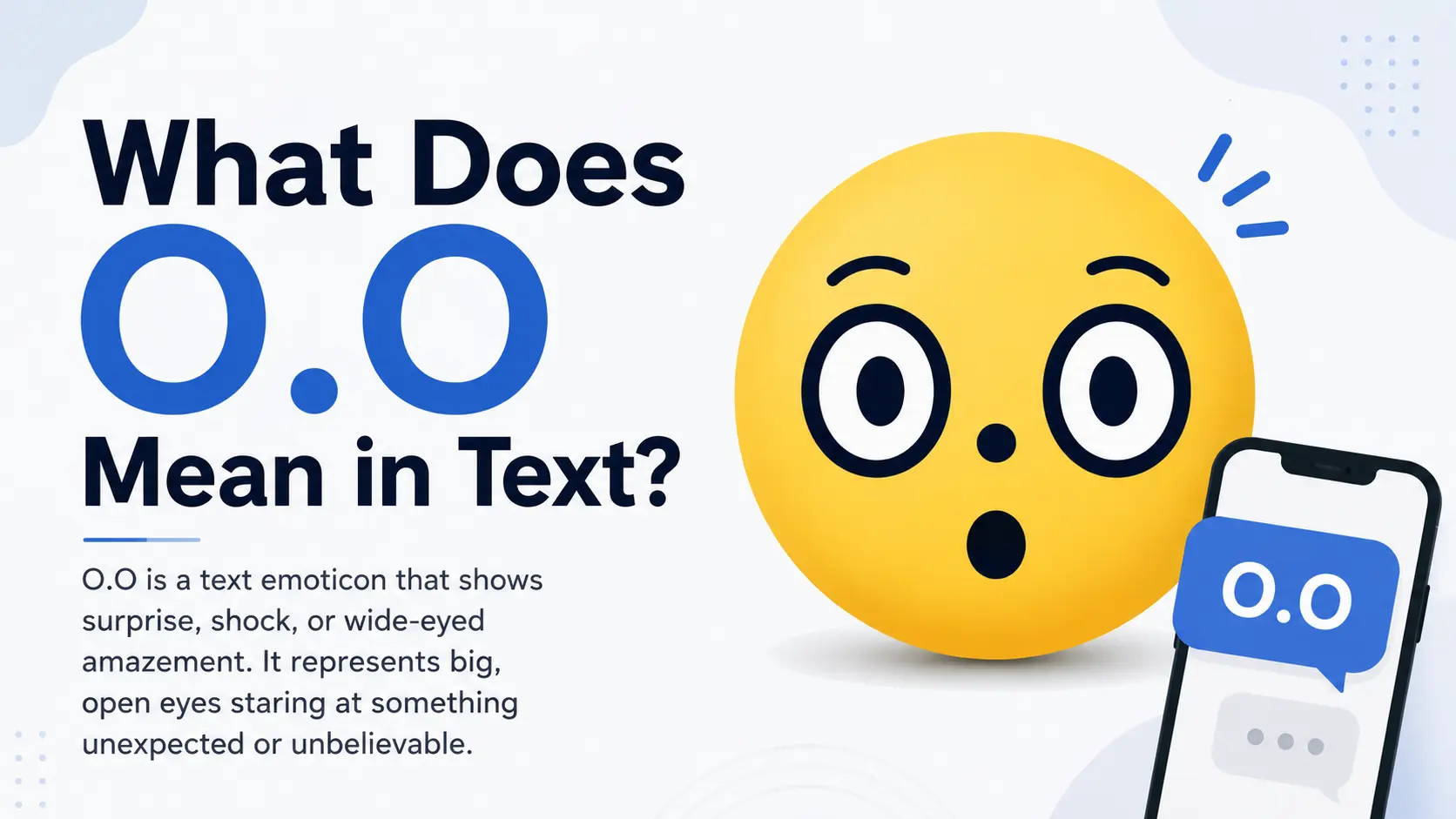
“O.O” is a text emoticon used to show:
- Shock
- Surprise
- Confusion
- Amazement
- Being speechless
- Mild disbelief
The two “O” letters represent wide-open eyes, while the dot in the middle acts like a nose. Together, it creates a surprised facial expression.
People usually use it when something unexpected happens or when they read something surprising.
Simple Examples
“You finished the whole project overnight? O.O”
“Wait… you met your celebrity crush? O.O”
“That plot twist was insane O.O”
The emotion behind it is usually playful, dramatic, curious, or stunned rather than negative.
Origin & Background of O.O
The expression “O.O” comes from early internet culture and old-school chatroom communication.
Before modern emojis became available on phones, people used keyboard characters to create emotional faces called emoticons. These symbols helped users express emotions in text-only conversations.
Expressions like these became popular on:
- MSN Messenger
- AOL chat rooms
- Yahoo Messenger
- Early forums
- Anime communities
- Gaming chats
“O.O” gained popularity because it visually looked like someone staring with huge eyes in shock.
Asian internet culture also influenced the rise of expressive emoticons. Anime and manga communities especially loved exaggerated reactions, and O.O fit perfectly into that style of communication.
Over time, the meaning evolved. Today, it can express anything from genuine surprise to sarcastic disbelief depending on context.
Social media platforms like TikTok, Discord, Reddit, Instagram, and Snapchat helped keep the expression alive even after emojis became dominant.
Interestingly, many users still prefer “O.O” because it feels more personal and expressive than a standard shocked emoji.
Real-Life Conversations Using O.O
WhatsApp Conversation
Person A:
I accidentally sent my boss the meme instead of the report.
Person B:
O.O wait WHAT happened after that?
Instagram DM
Person A:
Guess who followed me back today.
Person B:
Who??
Person A:
My favorite singer 😭
Person B:
O.O NO WAY
TikTok Comments
Person A:
This recipe actually worked perfectly on my first try.
Person B:
O.O impossible
Text Message
Person A:
I just got engaged.
Person B:
O.O THAT’S AMAZING
These examples show how flexible the expression can be. Sometimes it signals excitement, and other times it shows total disbelief.
Emotional & Psychological Meaning of O.O
At its core, O.O represents emotional intensity.
Humans naturally react with widened eyes when surprised, shocked, or curious. This emoticon mimics that facial reaction in digital communication.
That’s why it feels emotionally recognizable even without words.
People use O.O because it helps messages feel more human. Text conversations can easily feel cold or flat. Small emotional expressions add warmth, personality, and realism.
Psychologically, it also creates a feeling of instant reaction. Instead of writing a long response, users can quickly communicate:
- “I can’t believe this.”
- “That surprised me.”
- “I need more information.”
- “I’m stunned.”
I once saw a friend use O.O after hearing another friend secretly moved abroad without telling anyone. Nobody needed extra explanation. The expression alone perfectly captured the collective shock in the group chat.
That’s the power of internet body language.
Usage in Different Contexts
Social Media
On TikTok, Instagram, and X, O.O is often used in reactions to surprising content.
Examples include:
- Obsessed transformation videos
- Unexpected relationship reveals
- Plot twists
- Viral drama
- Shocking facts
It adds emotional flavor without needing a full sentence.
Friends & Relationships
Among friends, O.O feels casual and playful.
Someone might use it when:
- Hearing gossip
- Receiving exciting news
- Seeing a surprising photo
- Learning a secret
In relationships, it can even sound flirtatious or teasing depending on tone.
Example:
“You remembered my favorite coffee order? O.O”
Work & Professional Settings
Using O.O professionally is risky.
In casual workplace chats with coworkers, it may sometimes be acceptable. But in formal emails, meetings, or client communication, it can look immature or confusing.
Professional alternatives include:
- “That’s surprising.”
- “Interesting.”
- “I didn’t expect that.”
Casual vs Serious Tone
In casual settings, O.O usually feels harmless and expressive.
In serious conversations, however, it can accidentally seem insensitive or sarcastic if someone is discussing emotional topics.
Context matters a lot.
When NOT to Use O.O
Although O.O is usually harmless, there are situations where it may create misunderstanding.
During Serious Emotional Discussions
If someone shares painful news, using O.O may appear emotionally disconnected.
For example:
- Family loss
- Mental health struggles
- Personal trauma
A thoughtful response works better than a reaction emoticon.
Formal Communication
Avoid using it in:
- Job applications
- Business emails
- Academic writing
- Professional interviews
It can reduce credibility.
Cultural Misunderstandings
Not everyone understands internet slang equally. Older users or non-native English speakers may misinterpret the expression entirely.
Some people may think it looks strange or passive aggressive.
Common Misunderstandings About O.O
People Think It Means Anger
Because of the large eyes, some users mistakenly think O.O represents staring aggressively.
Usually, it actually signals surprise instead.
Tone Confusion
O.O can sometimes look sarcastic depending on the message.
Example:
“You forgot again? O.O”
This could sound joking or judgmental depending on the relationship.
Literal Interpretation
Some beginners think it is a typing error rather than an emoticon.
That confusion happens less today because internet slang has become more mainstream.
Comparison Table
| Expression | Meaning | Emotional Tone |
|---|---|---|
| O.O | Shock or surprise | Wide-eyed disbelief |
| 🙂 | Happiness | Friendly |
| :O | Strong surprise | Dramatic shock |
| -_- | Annoyance | Frustrated |
| XD | Laughing hard | Energetic humor |
| T_T | Crying | Sadness |
| :/ | Uncertainty | Awkward or doubtful |
| ^_^ | Joy | Cute happiness |
Key Insight
O.O stands out because it captures a very specific emotional moment: silent surprise. Unlike louder reactions such as “OMG,” it often feels more visual, subtle, and expressive.
Variations of O.O and Similar Types
O_O
A stronger version of surprise or staring intensely.
o.o
A softer, calmer variation often used casually.
O.O?
Shows confusion mixed with disbelief.
O.O!
Adds excitement or dramatic shock.
@.@
Represents dizziness or mental overload.
._.
Shows disappointment, awkwardness, or sadness.
:O
Classic open-mouth surprise.
owo
Cute excitement often used in anime or gaming communities.
UwU
Represents affection, softness, or happiness.
>.<
Embarrassment, frustration, or emotional overload.
These variations evolved naturally across online communities and fandom culture.
How to Respond When Someone Uses O.O
Casual Replies
- “I know right?”
- “Obsessed, isn’t it?”
- “I couldn’t believe it either.”
Funny Replies
- “Your eyes just got bigger through the screen.”
- “Don’t stare too hard 😂”
- “The drama continues.”
Mature Replies
- “Yeah, it surprised me too.”
- “It was definitely unexpected.”
- “I’m still processing it honestly.”
Respectful Replies
- “I understand why that’s shocking.”
- “It caught me off guard too.”
- “There’s more to the story actually.”
The best response depends on the emotional mood of the conversation.
Regional & Cultural Usage
Western Culture
In Western internet culture, O.O is mostly tied to surprise, humor, or awkward disbelief.
Millennials who grew up during the early internet era often recognize it instantly.
Asian Culture
Asian online communities, especially anime and gaming fandoms, helped popularize expressive emoticons like O.O.
The exaggerated facial style fits anime-inspired communication perfectly.
Middle Eastern Culture
Younger internet users in Middle Eastern countries often understand O.O through global social media exposure.
However, older generations may be less familiar with it.
Global Internet Usage
Today, O.O works almost like a universal internet reaction.
Because it visually resembles human emotion, people from many language backgrounds understand it even without translation.
Gen Z vs Millennials
Millennials
Millennials often see O.O as nostalgic internet slang from the MSN Messenger era.
Gen Z
Gen Z users may use it ironically, humorously, or aesthetically in meme culture.
Interestingly, Gen Z tends to mix old emoticons with modern emojis for comedic effect.
Example:
“You did WHAT O.O 💀”
Is O.O Safe for Kids?
Yes, O.O is generally safe for kids.
It is not considered offensive, explicit, or dangerous. It simply expresses surprise or shock.
However, parents should still pay attention to the overall conversation context online since meanings can shift depending on tone and community culture.
By itself, though, O.O is harmless internet slang.
Frequently Asked Questions
What does O.O mean from a girl?
Usually, it means surprise, curiosity, or disbelief. The meaning depends more on context than gender.
Is O.O flirting?
Sometimes it can sound playful or flirtatious, especially in casual conversations, but it is not automatically romantic.
What’s the difference between O.O and :O?
O.O focuses more on wide-eyed staring or silent shock, while :O represents open-mouth surprise.
Is O.O outdated?
Not completely. It’s older internet slang, but many people still use it for nostalgia, humor, or expressive texting.
Can O.O be sarcastic?
Yes. Tone and context can make it sound sarcastic or judgmental in some conversations.
Why do gamers use O.O?
Gamers often use quick emoticons to react instantly during fast conversations. O.O communicates surprise efficiently.
Does O.O mean confusion?
Sometimes. It can express confusion mixed with shock, especially when someone reads unexpected information.
Conclusion
The meaning of O.O in text is surprisingly simple once you understand the emotion behind it. It represents wide-eyed surprise, disbelief, curiosity, or stunned reaction in online conversations.
What makes O.O special is its human quality. Even with all the modern emojis available today, people still use classic emoticons because they feel personal, expressive, and emotionally recognizable.
Internet language continues to evolve, but small expressions like O.O remind us that digital communication is still deeply emotional. A few simple characters can instantly communicate feelings that would otherwise take sentences to explain.
So the next time someone sends you “O.O,” you’ll know they’re probably shocked, impressed, curious, or completely caught off guard.
And honestly, once you start noticing it, you’ll probably begin using it too.