
If you’ve received a text saying “AMC” and had no idea what it meant, you’re not alone. Modern texting culture is packed with abbreviations, acronyms, and slang that can change meaning depending on the conversation.
The term AMC appears in text messages, social media posts, online chats, gaming communities, and even professional discussions. Because it has multiple meanings, many people search for “what does AMC mean in text” to avoid confusion and understand the context correctly.
In this guide, you’ll learn the most common meaning of AMC in texting, where it came from, how people use it in real conversations, and how to respond naturally when someone sends it to you.
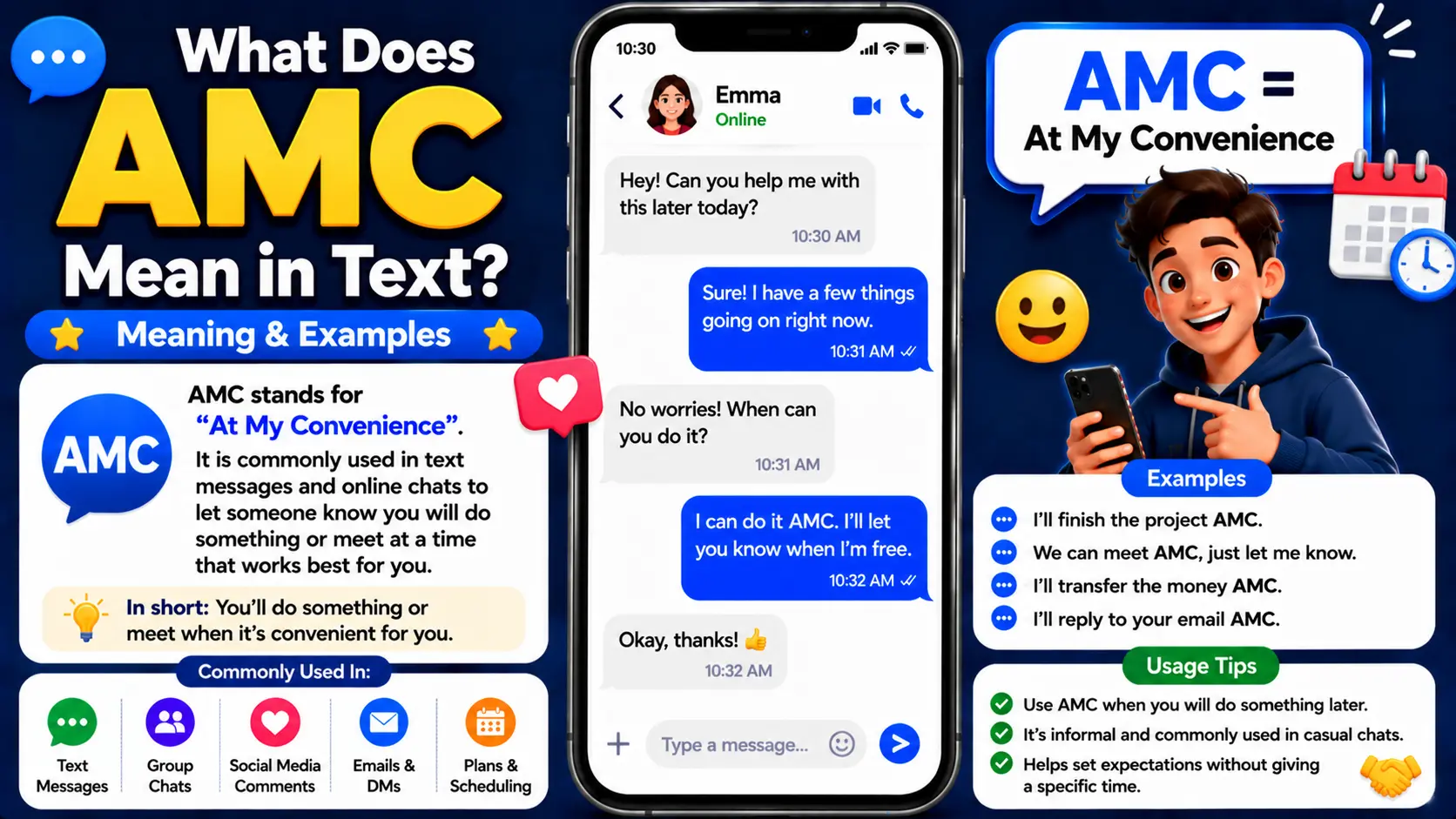
What Does AMC Mean in Text? – Quick Meaning
In texting, AMC most commonly stands for:
“Ain’t My Concern”
People use it to say that a situation, problem, or issue is not their responsibility or something they want to get involved in.
Simple Definition
AMC is a casual expression used when someone wants to distance themselves from a topic or avoid taking responsibility for something.
Examples
“They keep arguing, but AMC.”
“That’s between them. AMC.”
“I heard the drama, but AMC honestly.”
The tone can be neutral, humorous, dismissive, or even slightly rude depending on how it is used.
Origin & Background
Unlike many internet abbreviations that began on social media, AMC evolved from everyday spoken language.
The phrase “ain’t my concern” existed long before texting. As online communication became faster, users started shortening common phrases into easy-to-type acronyms.
Cultural Influence
Texting culture rewards speed and convenience. Acronyms such as LOL, BRB, IDK, and AMC became popular because they save time while expressing clear emotions.
Social Media Impact
Platforms like Instagram, TikTok, Snapchat, and X helped spread abbreviations quickly. Users often write AMC in comment sections when discussing online drama, celebrity gossip, or personal conflicts.
Evolution of Meaning
Although “Ain’t My Concern” is the most common texting meaning, AMC can also represent:
- American Movie Classics (TV network)
- AMC Theatres
- Asset Management Company
- Annual Maintenance Contract
This is why context is essential.
Real-Life Conversations
WhatsApp Conversation
Person A: Did you hear Sarah and Emma stopped talking?
Person B: Yeah, but AMC. That’s their business.
Instagram DM
Person A: Everyone is discussing that influencer drama.
Person B: Honestly AMC. I have enough going on already.
TikTok Comments
Person A: Why isn’t anyone defending him?
Person B: AMC. People should solve their own issues.
Text Message
Person A: Jake forgot to submit the project again.
Person B: AMC. He knew the deadline.
Emotional & Psychological Meaning
AMC may look like a simple abbreviation, but it often communicates deeper emotions.
It Expresses Boundaries
Many people use AMC to show they don’t want to become involved in someone else’s problems.
It Reflects Emotional Distance
Sometimes the sender wants to protect their peace by avoiding unnecessary stress.
It Can Signal Frustration
If someone repeatedly gets dragged into drama, AMC becomes a quick way of saying:
“I don’t want any part of this.”
It Can Sound Confident
People often use AMC when they have learned to focus on their own priorities rather than everyone else’s issues.
Personal-Style Scenario
Imagine you’re at work and coworkers keep discussing a disagreement between two team members. Instead of choosing sides, you reply:
“AMC. They’ll figure it out.”
The response helps you stay neutral and avoid becoming part of the conflict.
This is one reason AMC has become popular in modern communication. It allows people to establish personal boundaries quickly.
Usage in Different Contexts
Social Media
On social media, AMC often appears under posts involving arguments, controversies, or gossip.
Example:
“AMC. Not my situation.”
Friends & Relationships
Friends use AMC when they don’t want to get involved in another person’s disagreement.
Example:
“You two need to talk directly. AMC.”
Work or Professional Settings
Using AMC professionally is usually not recommended because it can sound dismissive.
Instead, people may say:
“This falls outside my responsibilities.”
Casual vs Serious Tone
Casual Use:
- Friendly conversations
- Group chats
- Social media comments
Serious Use:
- Can sound cold
- May appear uncaring
- Sometimes creates misunderstandings
Always consider the relationship and context before using it.
When NOT to Use It
Although AMC is common online, there are situations where it may be inappropriate.
During Sensitive Situations
Avoid using AMC when someone is sharing:
- Personal struggles
- Family issues
- Health concerns
- Emotional hardships
In Professional Communication
Managers, clients, and colleagues may view AMC as unprofessional.
When Support Is Expected
If a close friend genuinely needs help, AMC may seem insensitive.
Cross-Cultural Communication
Some people may not recognize the abbreviation and could misunderstand your intention.
Common Misunderstandings
Assuming It Always Means “Ain’t My Concern”
Many people think AMC has only one meaning. In reality, it can refer to companies, theaters, or business terms.
Tone Confusion
AMC can sound:
- Funny
- Neutral
- Dismissive
- Rude
The tone depends on wording and context.
Misreading the Situation
Someone using AMC may not be angry. They may simply be choosing not to get involved.
Literal vs Figurative Meaning
Literally, AMC means something isn’t your concern.
Figuratively, it can communicate:
- Boundary-setting
- Emotional detachment
- Prioritizing personal peace
Comparison Table
| Expression | Meaning | Tone |
|---|---|---|
| AMC | Ain’t My Concern | Dismissive or neutral |
| IDK | I Don’t Know | Neutral |
| NMP | Not My Problem | Stronger and harsher |
| IDC | I Don’t Care | Indifferent |
| MYOB | Mind Your Own Business | Direct |
| FYI | For Your Information | Informative |
| IMO | In My Opinion | Opinion-based |
| ICYMI | In Case You Missed It | Helpful |
Key Insight
AMC sits somewhere between neutrality and detachment. It usually sounds less harsh than “Not My Problem” but stronger than simply saying “I don’t know.”
Variations and Related Types
1. NMP
Meaning: Not My Problem
A stronger version of AMC.
2. IDC
Meaning: I Don’t Care
Focuses on lack of interest rather than responsibility.
3. MYOB
Meaning: Mind Your Own Business
Used when someone is being overly curious.
4. IDRC
Meaning: I Don’t Really Care
A softer form of indifference.
5. TBH
Meaning: To Be Honest
Often paired with AMC in conversations.
6. SMH
Meaning: Shaking My Head
Shows disappointment or disbelief.
7. ICYMI
Meaning: In Case You Missed It
Used to share updates or news.
8. IMO
Meaning: In My Opinion
Adds a personal perspective.
9. FWIW
Meaning: For What It’s Worth
Shares advice without pressure.
10. NM
Meaning: Never Mind
Used when a topic is no longer important.
How to Respond When Someone Uses AMC
Casual Replies
- “Fair enough.”
- “Got it.”
- “No worries.”
- “That’s understandable.”
Funny Replies
- “Peacefully avoiding drama, I see.”
- “Professional boundary expert.”
- “Staying out of trouble today?”
- “Smart move honestly.”
Mature Replies
- “I respect that.”
- “You’re right, it’s their issue to solve.”
- “Makes sense to stay neutral.”
Respectful Replies
- “Understood.”
- “Thanks for being honest.”
- “I appreciate your perspective.”
Regional & Cultural Usage
Western Culture
In North America and parts of Europe, AMC is often used casually to express independence and personal boundaries.
People generally understand the idea of staying out of drama.
Asian Culture
In many Asian cultures, harmony and group relationships can be highly valued.
Using AMC too directly may sometimes seem distant or impolite.
Middle Eastern Culture
Relationships and community connections often carry significant importance.
An AMC response might occasionally be viewed as less supportive than expected.
Global Internet Usage
Online communities have made AMC recognizable across countries.
However, meaning still depends heavily on context.
Gen Z vs Millennials
Gen Z
- Uses acronyms frequently
- Prefers short responses
- Often uses AMC humorously
Millennials
- More likely to spell out the full phrase
- May use AMC less frequently
- Often focus on context and tone
Is It Safe for Kids?
Yes, AMC is generally safe for kids because it does not contain offensive language or inappropriate content.
However, parents and educators should help young people understand context.
Using AMC repeatedly when friends need support could come across as dismissive or unsympathetic.
Teaching empathy alongside digital communication is important.
Frequently Asked Questions
What does AMC mean in a text message?
Most commonly, AMC means “Ain’t My Concern,” indicating that a situation is not the sender’s responsibility.
Is AMC rude?
Not necessarily. It depends on context and tone. It can sound neutral, humorous, or dismissive.
What does AMC mean on social media?
It often means “Ain’t My Concern,” especially in discussions involving gossip, drama, or disagreements.
Can AMC have other meanings?
Yes. It can also refer to AMC Theatres, American Movie Classics, Asset Management Company, or Annual Maintenance Contract.
Should I use AMC at work?
Generally no. Professional communication usually benefits from clearer and more formal wording.
Is AMC popular with Gen Z?
Yes. Gen Z users commonly use abbreviations like AMC in texting and social media conversations.
How do I know which AMC meaning applies?
Look at the context. If the conversation involves personal issues or drama, it usually means “Ain’t My Concern.”
Conclusion
Understanding what does AMC mean in text is easier once you recognize the context behind it. In most personal conversations, AMC stands for “Ain’t My Concern,” a quick way of expressing that a situation is not your responsibility or something you want to become involved in.
The popularity of AMC reflects a broader trend in digital communication. People want fast, efficient ways to express boundaries, opinions, and emotional distance. While the abbreviation can be useful, it works best when used thoughtfully and with awareness of how others may interpret it.
Whether you’re reading messages, scrolling through social media, or chatting with friends, knowing the meaning of AMC can help you understand conversations more accurately and communicate with greater confidence.