
In today’s digital world, text abbreviations appear everywhere. Whether you’re scrolling through social media, chatting with friends, or reading comments online, you’ve probably seen someone use “FB” and wondered what it means.
If you’ve searched for “whats FB mean in text”, you’re not alone. Many people encounter this abbreviation in messages and online conversations and become confused because it can have more than one meaning depending on the context.
The good news is that understanding FB is usually simple once you know where and how it’s being used. In most cases, FB refers to Facebook, but there are other interpretations that occasionally appear in texting, gaming, work conversations, and internet culture.
This guide explains the meaning of FB, its origins, how people use it in real conversations, and how to respond confidently when you see it.
FB Meaning in Text – Quick Meaning
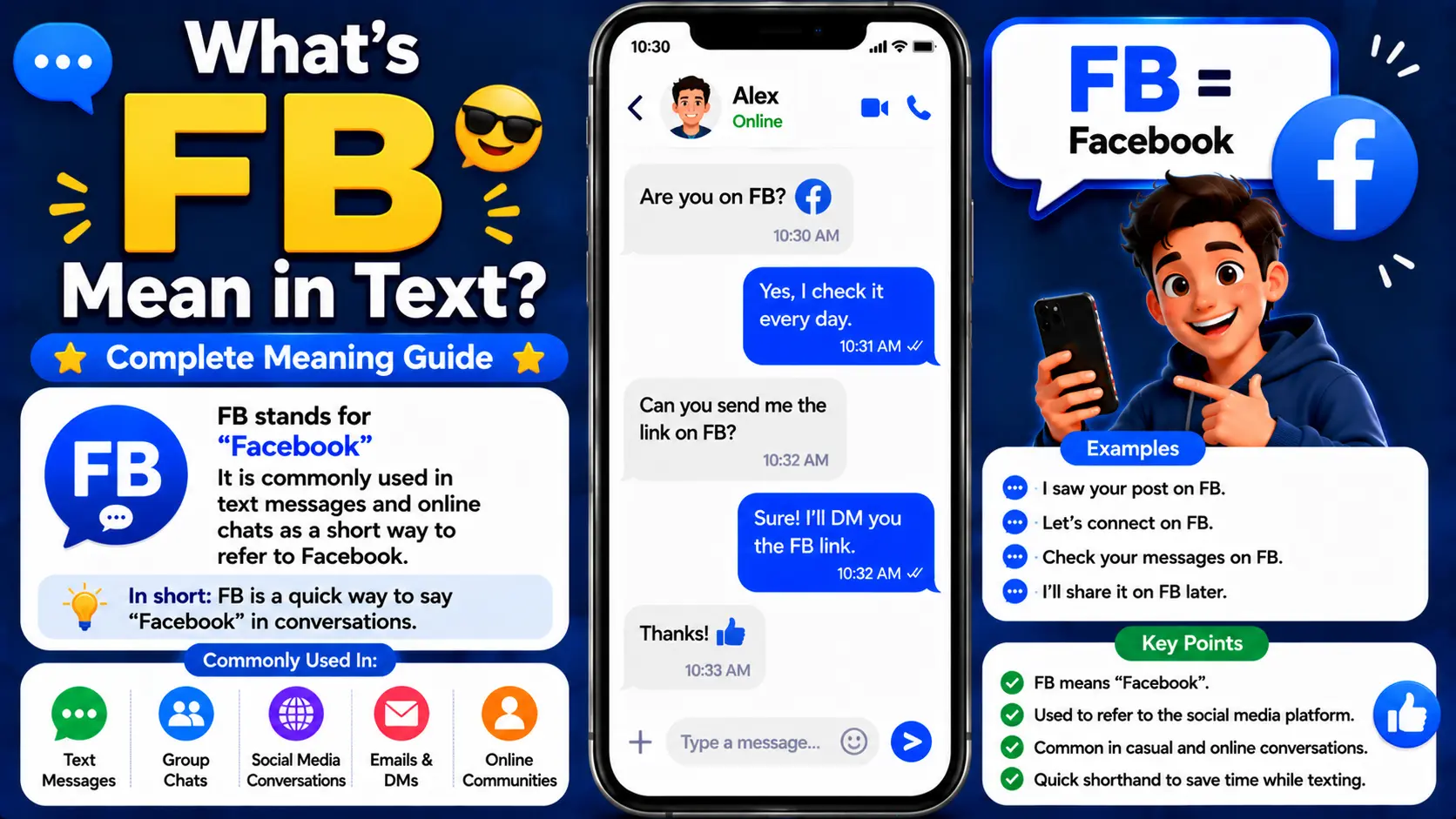
The most common meaning of FB in text is:
FB = Facebook
People often shorten Facebook to FB when texting because it is quicker and easier to type.
Common Uses
- Referring to a Facebook account
- Talking about Facebook posts
- Sharing Facebook links
- Mentioning Facebook Messenger
- Discussing activity on Facebook
Examples
“I saw your photos on FB.”
“Send me the link on FB.”
“Are you still using FB these days?”
In some situations, FB may also mean:
- Feedback
- Follow Back
- Friend Back
- Full Back (sports context)
However, Facebook remains the most widely recognized meaning.
Origin & Background
The abbreviation FB became popular as social media expanded during the late 2000s and early 2010s.
As texting evolved, people naturally shortened longer words and platform names. Just as Instagram became “IG” and Snapchat became “SC” in some conversations, Facebook became “FB.”
The rise of smartphones accelerated this trend. Users wanted faster communication, especially when typing on smaller screens.
Social media culture also played a major role. Influencers, marketers, students, and everyday users frequently referred to Facebook in discussions. Writing “FB” saved time while remaining easy to understand.
Over the years, FB became a universal internet shorthand. Even people who rarely use Facebook often recognize the abbreviation immediately.
Today, its meaning has expanded slightly because internet users sometimes use FB for “feedback” or “follow back,” but context usually makes the intended meaning obvious.
Real-Life Conversations
WhatsApp Conversation
Person A: Did you upload the wedding pictures?
Person B: Yes, they’re on FB already.
Person A: I’ll check them tonight.
Instagram DM
Person A: I can’t find your profile.
Person B: Search my FB account. The link is there.
Person A: Got it, thanks!
TikTok Comments
Person A: Where can I see more of your content?
Person B: Follow me on FB. I post longer videos there.
Text Message
Person A: Did Grandma see the family photos?
Person B: Yep, I posted them on FB yesterday.
Person A: Awesome!
Emotional & Psychological Meaning
At first glance, FB may seem like a simple abbreviation, but it reflects something larger about modern communication.
People value speed and convenience. Shortening Facebook to FB allows conversations to flow naturally without extra typing.
Using abbreviations also creates a sense of belonging. When people understand internet shorthand, they feel connected to digital culture and online communities.
There is also an emotional aspect. Many people associate Facebook with memories, family updates, friendships, and major life events. Mentioning FB can instantly bring those associations to mind.
For example, imagine reconnecting with an old friend. They text:
“I found our school pictures on FB.”
That simple abbreviation carries years of memories and shared experiences.
This demonstrates how small pieces of digital language can hold significant emotional meaning.
Usage in Different Contexts
Social Media
This is the most common setting.
Examples:
- “I shared it on FB.”
- “Check my FB profile.”
- “The event is on FB.”
Here, FB almost always means Facebook.
Friends and Relationships
Friends frequently use FB when discussing posts, photos, or messages.
Examples:
- “Did you see what she posted on FB?”
- “We became FB friends recently.”
The tone is casual and conversational.
Work and Professional Settings
In marketing, business, and customer service environments, FB often refers to Facebook as a platform.
Examples:
- “Our FB campaign performed well.”
- “The company posted an update on FB.”
Sometimes FB may also mean “feedback” in professional discussions.
Example:
- “Can you send me your FB on the presentation?”
Context is important here.
Casual vs Serious Tone
FB generally creates a casual tone.
Using the full word “Facebook” often sounds more formal or professional.
For instance:
- Casual: “I saw it on FB.”
- Formal: “I saw it on Facebook.”
Both are correct, but the tone differs.
When NOT to Use It
Although FB is widely understood, there are situations where using it may not be ideal.
Formal Business Documents
Professional reports and official documents should usually use the full word “Facebook.”
Academic Writing
Essays and research papers benefit from complete terminology.
International Audiences
Not everyone is familiar with internet abbreviations. Using FB may create confusion for some readers.
Important Instructions
If clarity matters, avoid abbreviations.
For example:
Instead of:
“Visit our FB page.”
Use:
“Visit our Facebook page.”
This reduces the chance of misunderstanding.
Common Misunderstandings
Assuming It Always Means Facebook
Sometimes FB means feedback.
Example:
“Please send FB after reviewing.”
In this case, the person is requesting feedback, not discussing Facebook.
Confusing Follow Back With Facebook
On social media, FB occasionally means “follow back.”
Example:
“FB please!”
This means:
“Please follow me back.”
Misreading Tone
Some users interpret abbreviations as overly casual.
In professional settings, this can affect how messages are received.
Missing Context
Context determines meaning. Reading only the abbreviation without considering the conversation often leads to confusion.
Comparison Table
| Expression | Meaning | Usage |
|---|---|---|
| FB | Social media discussions | |
| IG | Social media references | |
| X | X (formerly Twitter) | Platform discussions |
| SC | Snapchat | Casual conversations |
| Follow Back | Follow someone who followed you | Social media growth |
| Feedback | Opinion or review | Work and education |
| Unfriend | Remove a connection | Opposite social action |
| Add Friend | Create a connection | Related Facebook action |
Key Insight
While FB most commonly means Facebook, context remains the deciding factor. Understanding the surrounding conversation helps identify the intended meaning quickly and accurately.
Variations and Types of FB
1. FB (Facebook)
The most common meaning referring to the social media platform.
2. FB Friend
Someone connected with you on Facebook.
3. FB Post
A post shared on Facebook.
4. FB Group
A Facebook community organized around a topic or interest.
5. FB Messenger
Facebook’s messaging service.
6. FB Live
A live video broadcast on Facebook.
7. FB Story
A temporary story shared on Facebook.
8. FB Page
A public profile for businesses, creators, or organizations.
9. FB Feedback
Feedback given on a project or idea.
10. FB (Follow Back)
A request for mutual following on social platforms.
How to Respond When Someone Uses FB
Casual Replies
- “I’ll check it on FB.”
- “Send me the FB link.”
- “I saw it there too.”
Funny Replies
- “FB still exists? That’s impressive!”
- “My FB account remembers things I forgot.”
- “Time to log into FB after six months.”
Mature Replies
- “Thanks for sharing it on FB.”
- “I’ll review the information there.”
- “I appreciate the update.”
Respectful Replies
- “Thank you. I’ll take a look on Facebook.”
- “I found the page you mentioned.”
- “I appreciate you sending the link.”
Regional & Cultural Usage
Western Culture
In North America and Europe, FB is commonly understood as Facebook. Most internet users recognize it instantly.
Asian Culture
Many Asian users understand FB due to the platform’s global influence. However, local social platforms may be more dominant in some regions.
Middle Eastern Culture
FB is frequently used among social media users and is generally interpreted as Facebook unless another meaning is clearly intended.
Global Internet Usage
Across the internet, FB has become one of the most recognizable social media abbreviations.
It often appears in:
- Comments
- Forums
- Online communities
- Marketing discussions
- Digital communication
Gen Z vs Millennials
Gen Z
Younger users tend to use newer platforms more often and may mention FB less frequently.
Millennials
Millennials commonly use FB because many grew up during Facebook’s peak popularity.
As a result, Millennials often use the abbreviation naturally in conversations.
Is It Safe for Kids?
Yes, the abbreviation FB itself is generally safe for kids.
It is simply a shorthand term that usually refers to Facebook.
However, parents should pay attention to the overall conversation and online environment rather than focusing solely on the abbreviation. Context always matters when evaluating digital communication.
Frequently Asked Questions
What does FB mean in texting?
Most commonly, FB means Facebook.
Does FB always mean Facebook?
No. It can also mean feedback, follow back, or friend back depending on the context.
What does FB mean on Instagram?
It may mean Facebook or follow back. The surrounding conversation usually reveals the correct meaning.
What does FB mean in business messages?
It often means feedback, though it can also refer to Facebook marketing or advertising.
Is FB considered slang?
Not exactly. It is better described as an abbreviation or shorthand.
Why do people use FB instead of Facebook?
It saves time and makes typing faster.
Is FB still commonly used?
Yes. Although communication trends change, FB remains a widely recognized abbreviation online.
Conclusion
If you’ve been wondering “whats FB mean in text,” the answer is usually straightforward: FB most commonly means Facebook.
The abbreviation became popular because people wanted a quicker way to refer to one of the world’s largest social media platforms. Over time, it became part of everyday digital communication.
Still, context matters. In certain conversations, FB can also mean feedback, follow back, or friend back. Looking at the surrounding message will almost always reveal the intended meaning.
The next time you see FB in a text, comment, or direct message, you’ll be able to understand it confidently and respond naturally without second-guessing its meaning.