
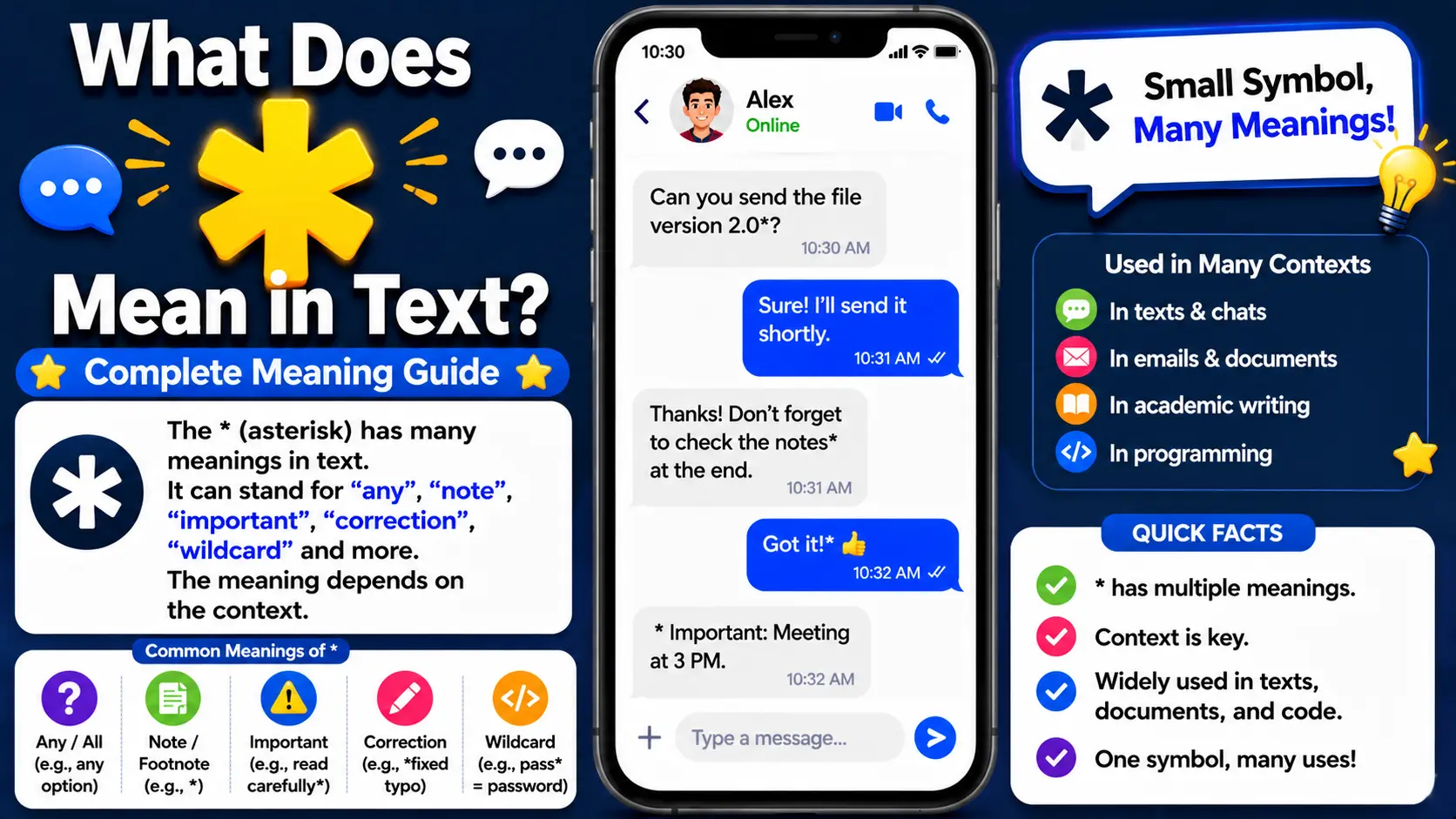
In texting, even the smallest symbol can completely change the tone of a message. One of the most confusing yet widely used symbols is the asterisk: *.
You have probably seen messages like:
- “I’m fine.”
- “That was amazing.”
- “sigh”
- “I didn’t mean that lol*”
At first glance, it looks simple. But depending on the context, the asterisk can show correction, emotion, sarcasm, emphasis, action, flirting, or even passive aggression.
That is why so many people search for “what does * mean in text.” The meaning changes based on who is using it, where it appears, and how the conversation feels emotionally.
This guide breaks everything down in a clear and realistic way so you can understand exactly what the asterisk means in modern communication.
* Meaning in Text – Quick Meaning
The symbol * in texting is called an asterisk.
In online conversations, it usually means one of these things:
- Emphasis or highlighting
- Correcting a typo
- Describing actions or emotions
- Adding sarcasm or dramatic tone
- Showing hidden emotional meaning
Simple Examples
“That was wild.”
Meaning: The speaker is emphasizing the word “wild.”
“Your*”
Meaning: They corrected a typo from a previous message.
“laughs nervously”
Meaning: The person is describing an action or emotion.
The meaning depends entirely on placement and tone.
Origin & Background
The asterisk existed long before texting.
Historically, it was used in writing, printing, and grammar to mark footnotes or important information. In literature and formal documents, the symbol acted like a small attention marker.
When internet chatrooms and early messaging apps became popular in the late 1990s and early 2000s, people started using * creatively because emotional expression was limited in plain text.
Before emojis existed, users typed things like:
*smiles**facepalm**hug*
This helped conversations feel more human.
Over time, social media platforms like Instagram, TikTok, Discord, Snapchat, and WhatsApp transformed the symbol into something emotionally layered.
Today, Gen Z often uses asterisks for:
- ironic humor
- fake narration
- emotional exaggeration
- meme culture
- soft sarcasm
A simple * can now communicate tone faster than a full sentence.
Real-Life Conversations
WhatsApp Conversation
Person A:
I guess you forgot about me 😒
Person B:
What? Nooo 😭 panics
Here, *panics* shows an emotional reaction in a playful way.
Instagram DM
Person A:
You looked good in that picture.
Person B:
blushes aggressively
The asterisk adds flirtation and dramatic humor.
TikTok Comments
Person A:
This song healed my depression.
Person B:
adds to playlist immediately
This format creates a relatable “action narration” style common on TikTok.
Text Message
Person A:
I cant believe I said that
Person B:
can’t*
Here, the asterisk corrects the typo.
Emotional & Psychological Meaning
The asterisk is powerful because it helps people express emotions indirectly.
Modern texting removes facial expressions, body language, and voice tone. Symbols like * fill that emotional gap.
People often use asterisks when they want to:
- soften awkwardness
- avoid sounding too serious
- add humor
- express emotions safely
- create dramatic effect
For many people, especially younger users, texting feels emotionally safer than speaking directly. The asterisk creates emotional distance while still communicating feeling.
For example:
“cries internally”
The person may genuinely feel stressed, but humor makes the emotion easier to share.
A Realistic Scenario
Imagine someone sends:
“Oh okay backs away slowly”
Technically, they are joking. But emotionally, they may feel rejected or embarrassed.
That is why understanding tone matters more than the actual symbol itself.
Usage in Different Contexts
Social Media
On TikTok, X, Instagram, and Reddit, asterisks often create comedic narration.
Examples:
*disappears forever**screaming internally**downloads immediately*
This style feels expressive, meme-like, and relatable.
Friends & Relationships
Among friends, * often adds humor or emotion.
Examples:
- “dies laughing”
- “throws phone”
- “fake cries”
In relationships, it can become flirtatious or emotionally suggestive.
Example:
“hugs you tightly”
This creates warmth without directly saying deep emotions.
Work & Professional Settings
In professional conversations, asterisks are usually used only for corrections.
Example:
“Tuesday*”
Using emotional roleplay like *cries* or *screams* at work can appear immature or confusing.
Casual vs Serious Tone
Casual:
“laughs that was funny”
Feels playful and relaxed.
Serious:
“I’m really disappointed.”
The asterisks emphasize emotional intensity.
When NOT to Use It
There are situations where using * can create misunderstandings.
Professional Emails
Avoid dramatic expressions like:
*dies inside**cries*
These may seem unprofessional.
Sensitive Conversations
If someone discusses grief, mental health, or serious conflict, ironic asterisk humor may feel dismissive.
Bad example:
“My dog passed away.”
Replying with:
“awkward silence”
could hurt the person emotionally.
Cross-Cultural Communication
Not everyone understands internet humor the same way. Older generations or non-native English speakers may misunderstand the tone completely.
Common Misunderstandings
People Think It Always Means Correction
Many users only know the typo-correction meaning.
Example:
“their*”
But online culture expanded the meaning far beyond grammar correction.
Tone Gets Misread
Example:
“Okay sure”
This could mean:
- genuine emphasis
- sarcasm
- annoyance
- passive aggression
Without voice tone, interpretation becomes subjective.
Literal vs Figurative Meaning
When someone says:
“dies”
they obviously are not being literal.
It simply exaggerates emotion for humor.
Some people unfamiliar with internet slang may misunderstand exaggerated expressions.
Comparison Table
| Expression | Meaning | Tone |
|---|---|---|
| laughs | Describes action | Playful |
| LOL | Laughing | Casual |
| sigh | Emotional reaction | Dramatic |
| FR | “For real” | Agreement |
| fine | Emphasis or sarcasm | Emotional |
| IDC | “I don’t care” | Detached |
| hugs | Comfort or affection | Warm |
| K. | Cold response | Passive-aggressive |
Key Insight
The asterisk is unique because it adds emotional performance to plain text. Unlike abbreviations, it creates atmosphere, tone, and personality inside a conversation.
Variations & Types
1. laughs
Shows amusement or playful reaction.
2. sigh
Expresses frustration, disappointment, or exhaustion.
3. facepalm
Shows embarrassment or disbelief.
4. dies laughing
Extreme laughter used dramatically.
5. blushes
Usually flirtatious or shy.
6. cries internally
Hidden stress or emotional overwhelm.
7. chef’s kiss
Means something is perfect or impressive.
8. awkward silence
Represents tension or discomfort.
9. slow clap
Sarcastic approval.
10. mic drop
Signals confidence or ending an argument strongly.
How to Respond When Someone Uses It
Casual Replies
- “LOL same”
- “You’re hilarious”
- “Mood honestly”
Funny Replies
- “calls the drama police”
- “pretends not to notice”
- “runs away dramatically”
Mature Replies
- “I understand what you mean.”
- “That sounds frustrating.”
- “Hope you’re okay.”
Respectful Replies
- “Thanks for explaining.”
- “I appreciate that.”
- “Got it.”
The best response depends on emotional context, not just the symbol itself.
Regional & Cultural Usage
Western Culture
In the US, UK, and Canada, asterisks are heavily tied to meme humor, sarcasm, and expressive texting.
Younger users especially use them as emotional narration.
Asian Culture
In countries like South Korea and Japan, expressive symbols and reaction-based texting are already common. Asterisks blend naturally with emoticons, emojis, and internet culture.
Anime fandom communities also popularized action-style expressions like:
“gasps dramatically”
Middle Eastern Culture
Usage varies widely.
Some younger users use asterisks exactly like Western internet culture, especially on TikTok and Instagram. Others may interpret them more literally.
Tone sensitivity matters more in multilingual conversations.
Global Internet Usage
Because meme culture spreads rapidly online, the asterisk has become globally recognizable among internet users under 35.
Still, meaning can differ depending on language fluency and online experience.
Gen Z vs Millennials
Gen Z
- Uses
*ironically and dramatically - Often layers humor with emotion
- Uses fake narration constantly
Example:
“evaporates from embarrassment”
Millennials
- More likely to use it for typo correction
- Uses emotional actions less frequently
- Simpler texting style overall
Is It Safe for Kids?
Generally, yes.
The asterisk itself is harmless and commonly used for humor, emphasis, or corrections.
However, parents should still understand context because online slang evolves quickly. Some expressions may carry sarcasm, emotional distress, or inappropriate jokes depending on the conversation.
Teaching kids about digital tone and respectful communication is more important than banning symbols.
FAQs
What does * mean after a word in text?
It usually corrects a typo from a previous message.
Example:
“your*”
Why do people use * around words?
To emphasize emotion, tone, or dramatic effect.
Example:
“That was amazing.”
What does sigh mean in texting?
It represents frustration, disappointment, exhaustion, or emotional reaction.
Is * used for sarcasm?
Sometimes, yes.
Example:
“Oh great.”
The tone often suggests annoyance or irony.
Why does Gen Z use * so much?
Gen Z uses it for expressive humor, emotional narration, and meme-style communication.
Can * be flirtatious?
Yes.
Expressions like *blushes* or *hugs* can create playful or romantic tone.
Is using * professional?
Only for typo corrections in formal settings. Dramatic expressions are usually too casual for work communication.
Conclusion
The asterisk may look like a tiny symbol, but in modern texting, it carries surprising emotional depth.
Depending on context, * can express humor, correction, embarrassment, sarcasm, affection, or dramatic storytelling. It reflects how digital communication keeps evolving to feel more human, emotional, and expressive.
Understanding the meaning behind symbols like this helps conversations feel clearer and more connected.
So the next time someone texts:
“cries dramatically”
you will know they probably are not actually crying. They are simply speaking the language of modern internet culture.