
If you’ve spent even a little time on social media, gaming chats, or texting apps, you’ve probably seen the term “OP” pop up again and again. It’s short, simple, and everywhere. But here’s the catch. It doesn’t always mean the same thing.
That’s exactly why people search for “op mean in text.” One person uses it to praise someone. Another uses it to refer to a post. And in gaming, it can even describe something unfairly powerful.
This confusion is real. You might see “OP” in a TikTok comment and assume one meaning, only to realize later it meant something completely different.
In this guide, we’ll break it all down in a clear, human way. No jargon. No guesswork. Just real understanding so you can use and interpret “OP” confidently in any situation.
OP Mean in Text – Quick Meaning
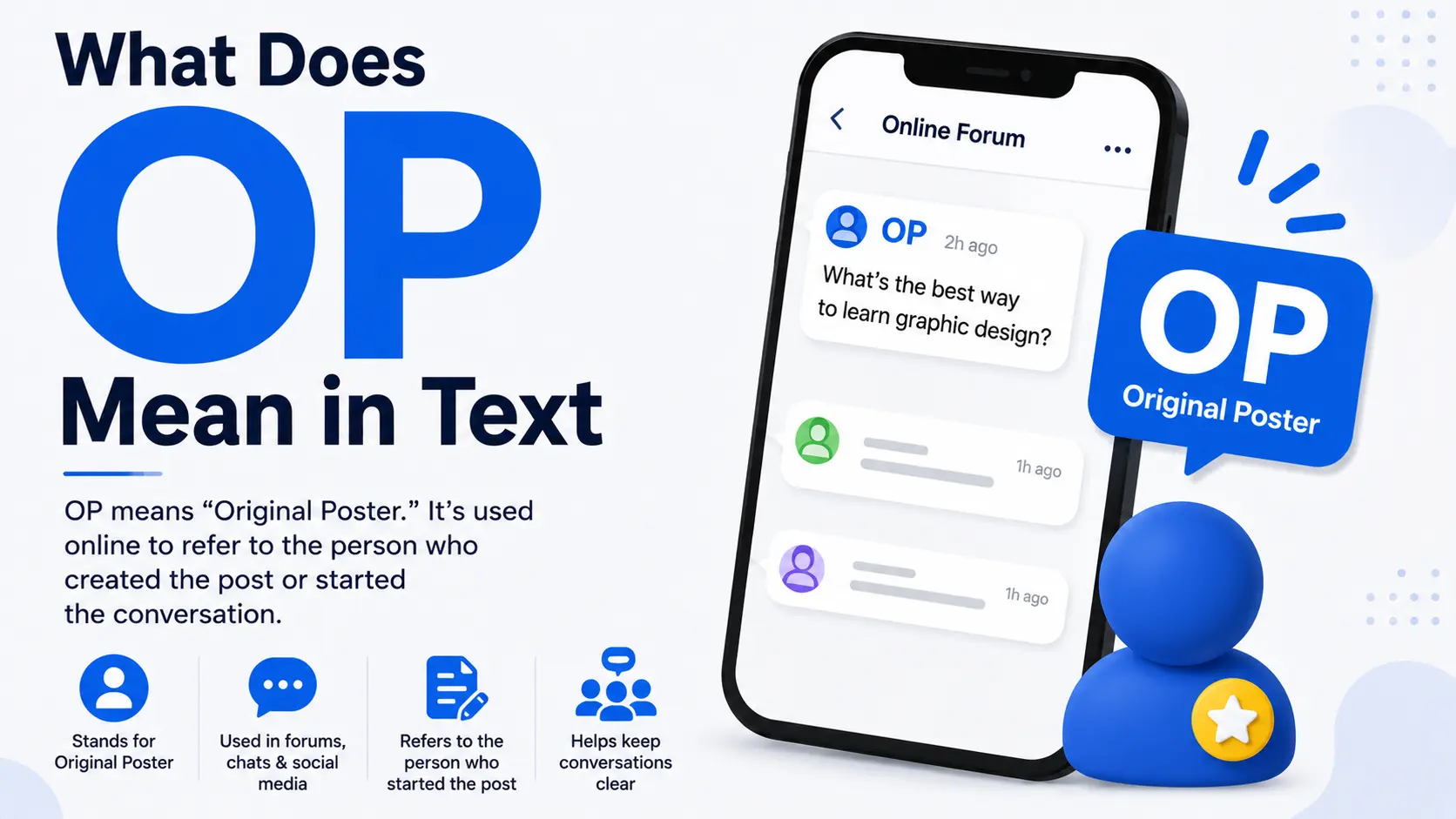
“OP” usually stands for one of two main things:
- Original Poster → the person who created a post
- Overpowered → something extremely strong or impressive
The meaning depends on the context.
Simple examples:
- “Ask OP for more details”
- “That move was OP!”
- “OP really explained this well”
Think of it like this. “OP” is a shortcut word that changes meaning based on where and how it’s used.
Origin & Background
The term “OP” didn’t start as a trendy slang word. It actually came from early internet forums.
Back in the days of message boards and discussion threads, people needed a quick way to refer to the person who started a conversation. Instead of typing “original poster” every time, they shortened it to “OP.”
Later, gaming communities adopted the same abbreviation, but gave it a new meaning. In competitive games, players began using “OP” to describe characters, weapons, or strategies that felt unfairly strong.
Then came social media. Platforms like Instagram, TikTok, and Reddit pushed “OP” into everyday language. Now, it lives in comments, captions, and DMs.
Over time, the meaning expanded. Today, “OP” can signal respect, humor, frustration, or even admiration depending on how it’s used.
Real-Life Conversations
Here’s how “OP” actually shows up in everyday conversations.
WhatsApp Chat
Person A: Did you see that message in the group?
Person B: Yeah, OP was clearly upset.
Instagram DM
Person A: This reel is hilarious 😂
Person B: OP deserves more followers honestly
TikTok Comments
Person A: How did you do this edit?
Person B: Ask OP, they replied earlier
Text Message
Person A: Bro your gameplay last night was outrageous
Person B: Haha thanks, that build is kinda OP
These examples show how flexible the term is. Same word, completely different meanings.
Emotional & Psychological Meaning
“OP” isn’t just a technical abbreviation. It carries emotion.
When someone says something is “OP,” they’re often expressing excitement, admiration, or even slight frustration. It can mean something is so good that it stands out.
When used as “original poster,” it reflects a social dynamic. It shows how people refer to others in digital spaces without needing names. It creates a sense of shared context.
There’s also a subtle psychological layer. Using slang like “OP” signals belonging. It tells others you understand the culture of that space.
A real-life scenario
Imagine you post a video you worked hard on. Someone comments, “OP nailed this.”
That small phrase can feel surprisingly powerful. It’s short, but it validates your effort.
Usage in Different Contexts
Social Media
On platforms like TikTok or Instagram, “OP” usually means the creator of the post. It’s used in comments to refer back to them.
Example: “OP already answered this in the caption”
Friends & Relationships
Among friends, “OP” is often used in a playful or casual way, especially in gaming or memes.
Example: “Your cooking skills are OP now”
Work or Professional Settings
This is where you need to be careful. “OP” is rarely used in formal communication. It can come off as too casual or unclear.
Better to say “original author” or “creator” instead.
Casual vs Serious Tone
- Casual: “That outfit is OP 🔥”
- Serious: “The original poster made an important point”
Tone matters a lot here.
When NOT to Use It
There are moments where using “OP” might create confusion or feel inappropriate.
- In formal emails or job communication
- When talking to someone unfamiliar with internet slang
- In sensitive discussions where clarity matters
- In cross-cultural conversations where meaning may be unclear
Using slang in the wrong context can make your message feel careless or misunderstood.
Common Misunderstandings
Many people assume “OP” has only one meaning. That’s where confusion starts.
What people often get wrong:
- Thinking it always means “overpowered”
- Misreading tone in comments
- Assuming it refers to a specific person without context
Tone confusion example:
“OP is mistaken”
This could be praise or criticism depending on the situation.
Understanding tone is just as important as understanding the word itself.
Comparison Table
| Term | Meaning | Usage |
|---|---|---|
| OP | Original poster / Overpowered | Context-dependent |
| GOAT | Greatest of all time | High praise |
| MVP | Most valuable player | Achievement-focused |
| Noob | Beginner or inexperienced | Can be teasing or insulting |
| Balanced | Fair and equal | Opposite of OP in gaming |
Key Insight
“OP” stands out because it has dual meanings. Unlike most slang, it shifts depending on the environment, which makes context everything.
Variations / Types
Here are some common variations you might see:
- OP AF → Extremely overpowered
- OP build → A very strong game setup
- OP move → A smart or unbeatable action
- OP comment → A standout or impressive reply
- OP energy → Confident and powerful vibe
- OP skills → Highly impressive abilities
- OP content → High-quality or viral content
- OP moment → A moment of excellence
- OP vibes → Strong, confident presence
- OP strategy → A winning or dominant approach
Each variation builds on the idea of something being above average.
How to Respond When Someone Uses It
Casual Replies
- “Haha I’ll take that 😄”
- “Glad you noticed!”
Funny Replies
- “Don’t expose my OP powers like that 😂”
- “Too strong, nerf me pls”
Mature Replies
- “I appreciate that, thank you”
- “That means a lot coming from you”
Respectful Replies
- “Thanks for your kind words”
- “I’m happy it helped”
Your response should match the tone of the conversation.
Regional & Cultural Usage
Western Culture
“OP” is widely used and easily understood, especially in gaming and online communities.
Asian Culture
It’s popular in gaming circles but less common in everyday texting unless influenced by global platforms.
Middle Eastern Culture
Usage is growing, especially among younger users. Still, not everyone may recognize it instantly.
Global Internet Usage
Thanks to social media, “OP” has become a universal term. But meaning still depends on context.
Generational Differences
- Gen Z → Uses it naturally and frequently
- Millennials → Understand it but may use it less often
Is It Safe for Kids?
Yes, “OP” is generally safe.
It doesn’t carry harmful or inappropriate meaning. However, kids should still understand context so they don’t misuse it or misinterpret others.
Guidance matters more than restriction here.
FAQs
1. What does OP mean in texting?
It usually means “original poster” or “overpowered,” depending on the context.
2. How do I know which meaning is correct?
Look at the situation. If it’s a discussion thread, it means original poster. In gaming or praise, it means overpowered.
3. Is OP a compliment?
Sometimes, yes. When it means “overpowered,” it often expresses admiration.
4. Can OP be negative?
It can be. In gaming, calling something OP might mean it’s unfair or unbalanced.
5. Is OP formal or informal?
It’s informal and best used in casual conversations.
6. Do adults use OP?
Yes, especially those familiar with online communities.
7. Is OP used worldwide?
Yes, but understanding may vary depending on region and exposure to internet culture.
Conclusion
“OP” is one of those small words that carries big meaning.
It can point to a person, highlight excellence, or even spark debate depending on how it’s used. That flexibility is what makes it powerful but also confusing at times.
Once you understand the context, everything clicks into place. You stop second-guessing and start communicating with confidence.
Language online is always evolving. Words like “OP” remind us that communication today is fast, creative, and deeply connected to culture.
Use it naturally. Pay attention to context. And most importantly, don’t overthink it.