
If you have seen the abbreviation “WFA” in a text message, chat, or social media comment and felt confused, you are not alone. Modern digital communication is full of short forms that change meaning depending on context, and WFA is one of those flexible expressions that often causes misunderstanding.
People search for “what does wfa mean in text” because it does not have just one fixed meaning. It can change based on who is using it, where it appears, and the tone of the conversation. In some cases, it is professional. In others, it is casual or even emotional.
Understanding WFA is not just about decoding letters. It is about understanding how people communicate in fast, digital spaces where every second and character matters.
This guide breaks down everything in a simple, human way so you can confidently understand and use it in real conversations.
3️⃣ WFA – Quick Meaning
WFA is an abbreviation that can have multiple meanings in text conversations. The most common ones include:
- Work From Anywhere (modern workplace and remote jobs)
- Wait For Answer (casual texting shorthand)
- Away From Keyboard / Away (less common variation in chats)
Example meanings in real use:
- “I am on WFA today, so I will join the meeting from home.”
- “Send me the details WFA, I will reply soon.”
- “He is WFA right now, probably busy.”
The meaning depends heavily on context, especially whether the conversation is professional or personal.
4️⃣ Origin & Background
WFA became widely used as remote work culture expanded globally. As companies shifted from office-based setups to flexible working models, abbreviations like WFH (Work From Home) and WFA (Work From Anywhere) started appearing in chats, emails, and workplace apps.
The second meaning, “Wait For Answer,” comes from informal texting culture. People prefer shorter messages when replying quickly, especially in group chats or fast conversations.
Over time, social media platforms like WhatsApp, Instagram, and Slack helped spread the abbreviation across different age groups and professions.
Today, WFA is a hybrid term. It belongs both to workplace vocabulary and casual internet slang.
5️⃣ Real-Life Conversations (MANDATORY)
💬 WhatsApp Conversation (Work Context)
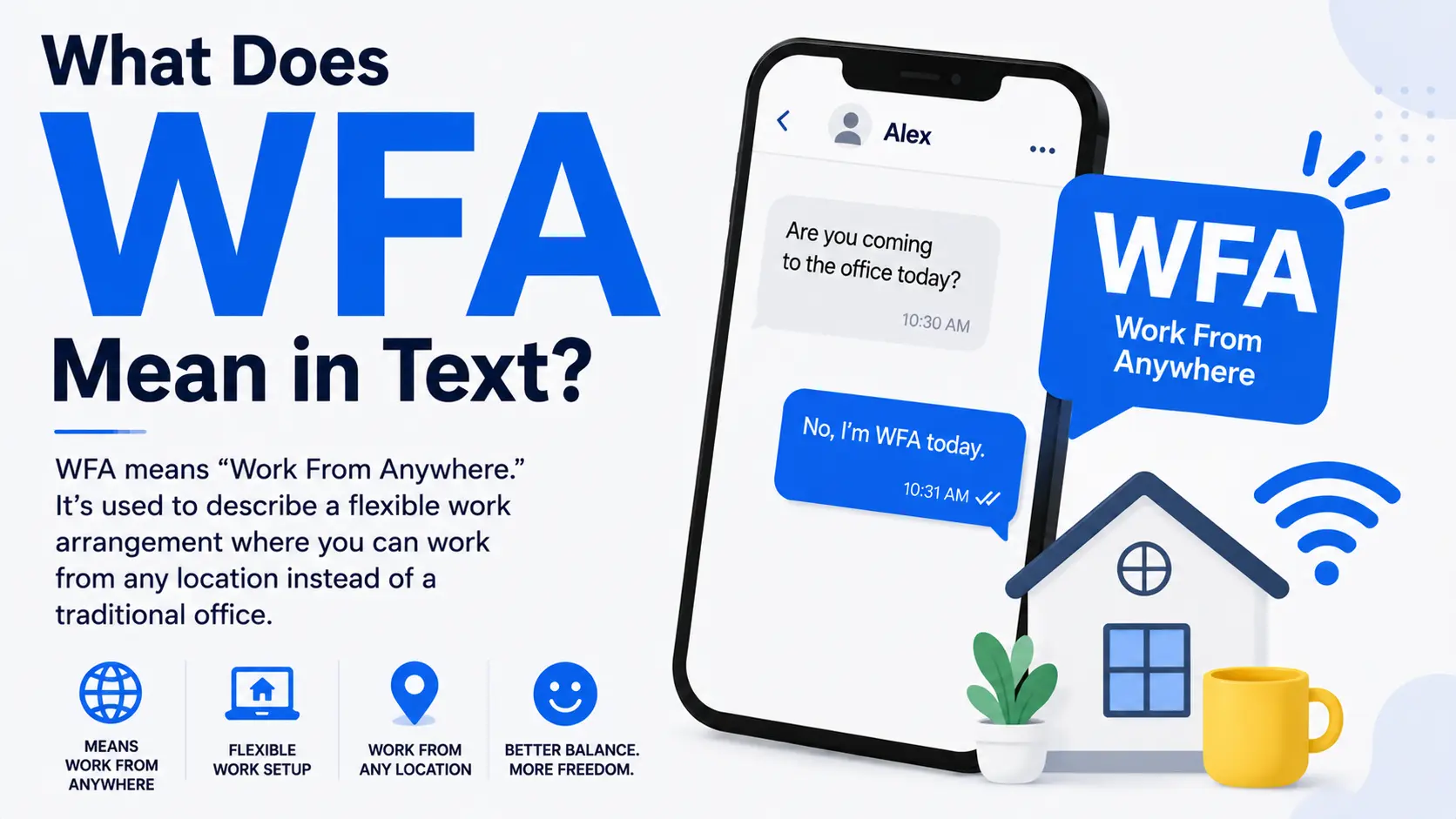
Person A: Are you coming to office today?
Person B: No, I am WFA today. Client calls from home.
💬 Instagram DM (Casual Chat)
Person A: Did you see my story?
Person B: Yes, WFA I will reply properly in a bit.
💬 TikTok Comment Thread
Person A: How do you manage work and travel?
Person B: I am WFA most of the time, so it’s flexible.
💬 Text Message (Friend Chat)
Person A: What happened with your exam result?
Person B: WFA I am still waiting for final update.
These examples show how flexible WFA becomes depending on tone and situation.
6️⃣ Emotional & Psychological Meaning
WFA reflects something deeper than just words. It shows how modern communication values speed, flexibility, and emotional efficiency.
When someone uses WFA, it often reveals:
- They are busy but still connected
- They want to delay response without ignoring someone
- They are part of a fast-moving digital lifestyle
Real-life scenario
Imagine someone working remotely while traveling. Instead of explaining a long message, they simply type “WFA today.” It saves time, reduces effort, and keeps communication smooth.
Psychologically, abbreviations like WFA also reduce social pressure. People feel less obligated to give long explanations, especially in group chats or professional spaces.
7️⃣ Usage in Different Contexts
📱 Social Media
Used in captions or comments about remote work or lifestyle flexibility.
- “Living the WFA life ✨”
💬 Friends & Relationships
Used casually to delay replies or explain availability.
- “WFA right now, talk later”
💼 Work / Professional Settings
Most commonly used here as “Work From Anywhere.”
- “Our company supports WFA policy”
⚖️ Casual vs Serious Tone
- Casual: “WFA, brb”
- Professional: “I am on WFA schedule today”
8️⃣ When NOT to Use It
Even though WFA is widely used, it is not always appropriate.
Avoid using it when:
- Talking to someone unfamiliar with internet slang
- Writing formal emails to clients who may not understand abbreviations
- In sensitive or emotional conversations where clarity is important
- When instructions or deadlines need precision
Using abbreviations in the wrong setting can cause confusion or seem unprofessional.
9️⃣ Common Misunderstandings
Many people misinterpret WFA because of its flexible meaning.
Common mistakes include:
- Thinking it only means “Work From Anywhere”
- Assuming it always relates to jobs
- Misreading it as a rude or dismissive reply
- Confusing it with similar slang like “WTF” or “WYA”
Tone also plays a big role. “WFA” in a serious message is different from “WFA lol” in a casual chat.
🔟 Comparison Table
| Term | Meaning | Usage | Tone |
|---|---|---|---|
| WFA | Work From Anywhere / Wait For Answer | Work, casual chat | Neutral |
| WFH | Work From Home | Office remote work | Professional |
| WYA | Where You At | Friends texting | Casual |
| BRB | Be Right Back | Temporary absence | Informal |
| AFK | Away From Keyboard | Gaming or online chats | Neutral |
Key Insight
WFA stands out because it is flexible across both professional and casual communication, unlike most slang that stays in one category.
1️⃣1️⃣ Variations / Types
Here are common variations related to WFA:
- WFA (Work From Anywhere) – Remote work flexibility
- WFA (Wait For Answer) – Delayed response in chats
- WFA mode – Informal way of saying remote working state
- On WFA – Currently working remotely
- WFA life – Lifestyle of remote workers
- WFA setup – Work environment outside office
- WFA schedule – Assigned remote working days
- WFA status – Availability update
- WFA policy – Company remote work rules
- WFA today – Working remotely today
1️⃣2️⃣ How to Respond When Someone Uses It
🙂 Casual Replies
- “Okay, take your time”
- “Got it, talk later”
- “No worries”
😄 Funny Replies
- “Living the dream WFA life huh”
- “Send me your WFA vibes”
- “Can I join your WFA club?”
🧠 Mature Replies
- “Understood, I will wait for your response”
- “Thanks for letting me know your availability”
- “We will connect once you are free”
🙏 Respectful Replies
- “Okay, I will reach out later”
- “Noted, take your time”
- “Hope your work goes smoothly”
1️⃣3️⃣ Regional & Cultural Usage
🌍 Western Culture
Mostly used as “Work From Anywhere,” especially in tech and corporate environments.
🌏 Asian Culture
Often used in hybrid meaning, both professional and casual chats.
🕌 Middle Eastern Culture
More commonly understood in workplace contexts, especially multinational companies.
🌐 Global Internet Usage
Social media has made WFA widely recognized among younger users worldwide.
👥 Generational Differences
- Gen Z: Uses it casually in chats and memes
- Millennials: Mostly use it for work-related communication
- Older generations: May find it confusing or unclear
1️⃣4️⃣ Is It Safe for Kids?
Yes, WFA is generally safe because it is not offensive or harmful. However, children may not always understand its meaning without explanation. It is best used in educational or supervised digital environments so they learn proper context.
1️⃣5️⃣ FAQs
1. What does WFA mean in text messages?
It usually means “Work From Anywhere” or “Wait For Answer” depending on context.
2. Is WFA a professional term?
Yes, in workplace settings it often refers to remote work flexibility.
3. Can WFA mean I am busy?
Yes, in casual chats it can imply you are unavailable or waiting to respond.
4. Is WFA the same as WFH?
No, WFH means Work From Home, while WFA means Work From Anywhere.
5. Why do people use WFA instead of full words?
Because it saves time and makes communication faster.
6. Is WFA slang or official term?
It is both. It is used in professional and informal communication.
7. Can I use WFA in emails?
Only in informal or internal workplace communication, not formal emails.
1️⃣6️⃣ Conclusion
WFA is a modern abbreviation that reflects how digital communication is evolving. Whether it means Work From Anywhere or Wait For Answer, its purpose is always the same: to make conversations faster, simpler, and more efficient.
Understanding WFA helps you avoid confusion and communicate more naturally in both personal and professional spaces. Like many internet abbreviations, its meaning depends on context, tone, and relationship between speakers.
Once you get used to it, WFA becomes a small but powerful part of everyday digital language that makes conversations smoother and more connected.