
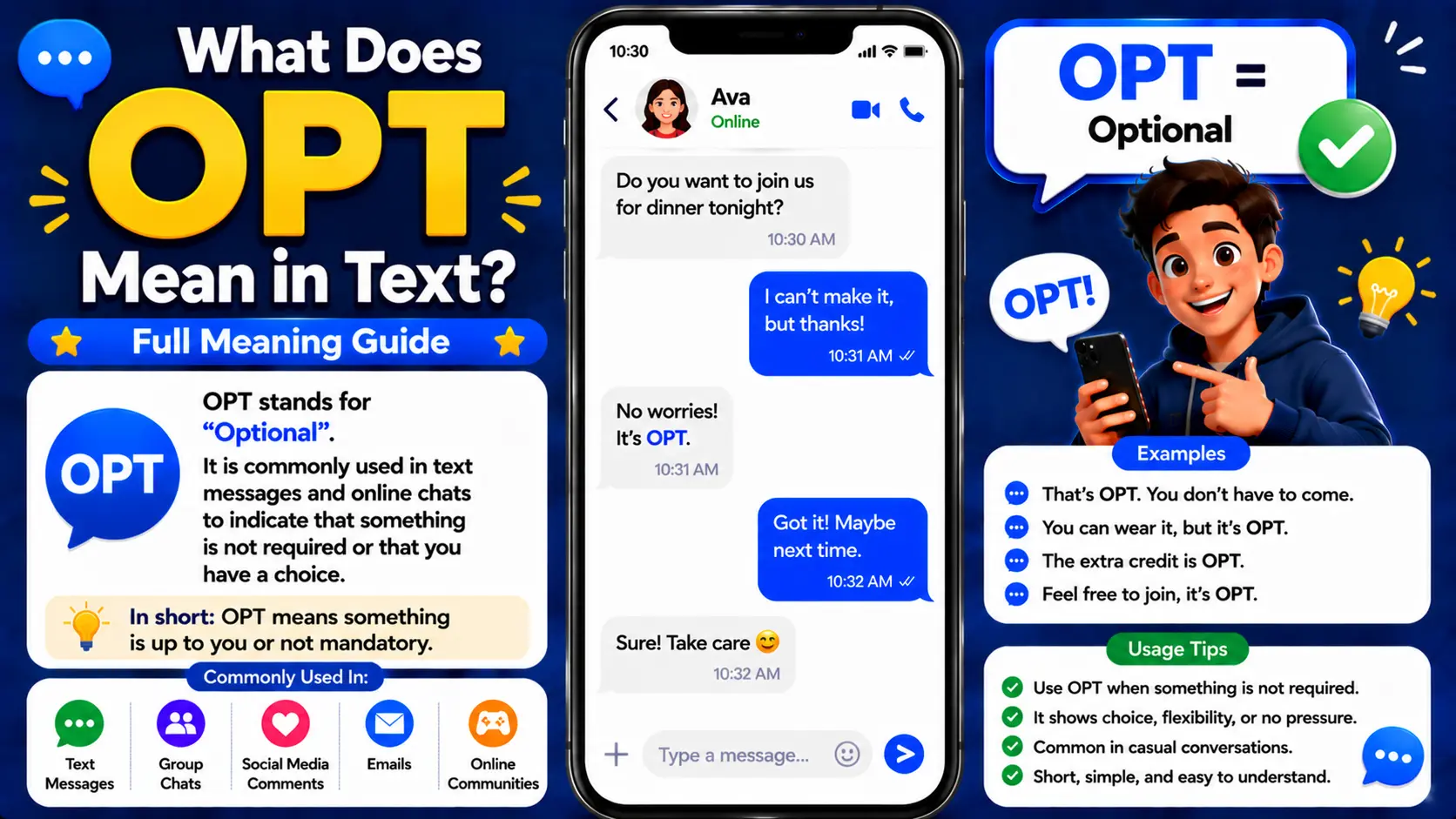
When you see “OPT” in a text message, TikTok comment, Snapchat streak, or Instagram DM, it can feel confusing at first because the meaning changes depending on the conversation.
Some people use it casually with friends. Others use it in arguments, online slang, or even professional settings. That is exactly why so many people search for “what dose opt mean in text” online.
In modern texting culture, short forms move fast. A word can carry different emotions depending on tone, platform, and relationship. Understanding the real meaning behind “OPT” helps you avoid awkward misunderstandings and communicate more confidently online.
This guide breaks down everything in simple language, including real-life examples, emotional meaning, social media usage, cultural context, and the most common mistakes people make with the term.
OPT Meaning in Text – Quick Answer
In texting, OPT usually means:
- To choose something
- To select an option
- To decide on one thing instead of another
It comes from the verb “opt,” as in:
- “I’ll opt for coffee.”
- “She opted out.”
- “He opted in.”
In online communication, people shorten sentences and simply type “opt” when talking about decisions or preferences.
Quick Examples
“I might opt for the blue one.”
“He opted out of the group chat.”
“You can opt in if you want updates.”
The exact meaning depends on the sentence and emotional tone.
Origin & Background of OPT
The word “opt” is not new slang. It actually comes from traditional English vocabulary and has been used for centuries.
It originates from the Latin word optare, which means “to choose” or “to wish for.”
Over time, the word became common in formal English:
- opt in
- opt out
- opt for
But texting culture changed how people use it.
Instead of writing:
- “I decided not to join.”
People now say:
- “I opted out.”
Social media helped shorten communication even more. Platforms like TikTok, Snapchat, Instagram, and X made quick messaging the norm. Short, efficient wording became popular because people wanted faster conversations.
Today, “OPT” appears in:
- text messages
- online forms
- subscription settings
- meme culture
- comment sections
- relationship conversations
Its meaning evolved from formal English into a modern digital communication shortcut.
Real-Life Conversations Using OPT
WhatsApp Conversation
Person A:
Movie tonight?
Person B:
I might opt for staying home honestly. Long day 😭
Instagram DM
Person A:
Why didn’t you join the livestream?
Person B:
I opted out. Needed a social media break.
TikTok Comments
Person A:
Would you rather travel or save money?
Person B:
Definitely gonna opt for travel ✈️
Text Message Conversation
Person A:
You joining the team dinner?
Person B:
Nah, I think I’ll opt out this time.
These examples show how natural and emotionally flexible the word has become in everyday communication.
Emotional & Psychological Meaning Behind OPT
Interestingly, “OPT” often reflects personal control and emotional boundaries.
When people use words like:
- “opt out”
- “opt in”
- “opt for”
they are expressing choice, independence, and preference.
In modern communication, especially online, people value autonomy more than ever. Saying “I opted out” sounds softer and less confrontational than saying:
- “I refused.”
- “I don’t want to.”
- “Leave me alone.”
That subtle emotional difference matters.
For example, someone might say:
“I opted out of the party.”
Psychologically, this sounds calm, mature, and self-aware instead of dramatic.
Personal-Style Scenario
A friend once stopped replying regularly in a group chat because constant notifications were affecting their mental focus. Instead of creating conflict, they simply messaged:
“I’m gonna opt out for a bit. Need some quiet time.”
Everyone understood immediately. The wording felt respectful instead of cold.
That is one reason “opt” feels emotionally intelligent in digital conversations.
How OPT Is Used in Different Contexts
Social Media Usage
On social media, OPT often appears in:
- captions
- comments
- polls
- debates
- preference discussions
Example:
“I’d opt for the original version honestly.”
People use it to sound casual but clear.
Friends & Relationships
Among friends or couples, “opt” can soften decisions.
Example:
“I think I’ll opt for a quiet night instead.”
This sounds gentler than rejecting plans directly.
Work & Professional Settings
In workplaces, the word is extremely common.
Examples:
- opt into benefits
- opt out of emails
- opt for remote work
Professional communication uses “opt” because it sounds polite and neutral.
Casual vs Serious Tone
The tone changes depending on context.
Casual
“I’ll probably opt for pizza 😂”
Serious
“Employees may opt out of the policy update.”
The word adapts easily to both informal and formal situations.
When NOT to Use OPT
Even though the term is useful, there are moments where it may sound inappropriate or confusing.
During Emotional Arguments
If someone is upset, saying:
“I opted out of the conversation.”
can sound emotionally distant or dismissive.
In Sensitive Situations
Topics involving grief, illness, or serious emotional discussions usually need warmer language.
Instead of:
“I opted out.”
something more empathetic may work better.
With People Unfamiliar With English Slang
Older users or non-native English speakers may misunderstand the phrase entirely.
When Clarity Matters
In emergencies or urgent situations, simple direct wording is better than vague internet-style communication.
Common Misunderstandings About OPT
Many people misunderstand “OPT” because they assume it is internet slang only.
Here are the most common confusions.
Thinking It Is an Acronym
Some users believe OPT stands for hidden words in every situation. Usually, it does not.
Most of the time, it is simply the English verb “opt.”
Confusing “Opt Out” With Rejection
“Opt out” often sounds softer than outright rejection.
It usually means:
- choosing not to participate
- stepping away respectfully
- protecting personal comfort
Tone Misreading
Text lacks facial expressions and voice tone.
So:
“I’ll opt out.”
might sound polite to one person but cold to another.
Tone depends heavily on relationship and context.
OPT Compared With Similar Expressions
| Expression | Meaning | Tone | Usage Style |
|---|---|---|---|
| OPT | To choose or decline | Neutral | Flexible |
| Pass | Decline casually | Informal | Friendly |
| Skip | Avoid something | Casual | Relaxed |
| Refuse | Reject directly | Strong | Serious |
| Join in | Participate | Positive | Social |
| Opt out | Choose not to participate | Polite | Professional |
| Opt in | Choose to participate | Neutral | Formal |
| Go with | Select casually | Relaxed | Conversational |
Key Insight
“OPT” stands out because it feels balanced. It is neither too emotional nor too cold. That makes it popular in modern texting where people want to communicate clearly without sounding aggressive.
Variations and Types of OPT
Here are the most common forms people use online.
1. Opt In
Choosing to participate in something.
Example:
“You can opt in for notifications.”
2. Opt Out
Choosing not to participate.
Example:
“I opted out of the meeting.”
3. Opt For
Selecting one option over another.
Example:
“I’ll opt for the black hoodie.”
4. Optional
Something not required.
Example:
“Attendance is optional.”
5. OPT-IN Email
Marketing emails users choose to receive.
Common in business settings.
6. Double Opt-In
A confirmation step after signing up online.
Usually for subscriptions.
7. Selective Opting
Choosing only certain parts of something.
Example:
“She opted into alerts but not newsletters.”
8. Silent Opt-Out
Leaving quietly without announcement.
Common in online communities.
9. Social Opt-Out
Avoiding events or online interaction temporarily.
Often linked to mental wellness.
10. Default Opt-In
Automatic participation unless users decline.
Common in apps and websites.
How to Respond When Someone Uses OPT
Your response depends on tone and relationship.
Casual Replies
- “Makes sense honestly.”
- “Yeah, I’d probably do the same.”
- “Fair choice.”
Funny Replies
- “Bold move 😂”
- “You really said nope.”
- “Respect the escape plan.”
Mature Replies
- “I completely understand.”
- “Thanks for letting me know.”
- “Hope everything’s okay.”
Respectful Replies
- “No pressure at all.”
- “Take care of yourself first.”
- “You’re always welcome later.”
Good responses acknowledge the person’s choice without guilt-tripping them.
Regional & Cultural Usage of OPT
Western Culture
In Western countries, especially the United States and the UK, “opt out” is extremely common.
People often use it to express:
- personal boundaries
- independence
- self-prioritization
It fits modern communication styles that value individual choice.
Asian Culture
In many Asian cultures, communication tends to be more indirect and group-focused.
Using “opt out” politely can help avoid open confrontation, especially in professional or social situations.
Middle Eastern Culture
In Middle Eastern communication, relationship warmth is often highly valued.
A phrase like:
“I opted out.”
may sound overly formal unless softened with kindness or explanation.
Global Internet Usage
Online culture has made “OPT” universally recognizable among younger internet users.
TikTok, gaming communities, and social apps helped normalize the phrase worldwide.
Gen Z vs Millennials
Gen Z
Uses “opt out” casually and frequently, especially regarding:
- social events
- trends
- online drama
- digital detoxes
Millennials
Usually use it more formally or professionally.
The generational difference mostly comes down to tone and frequency.
Is OPT Safe for Kids?
Yes, generally “OPT” is safe for kids because the word itself is neutral.
However, context matters.
For example:
- “opt in”
- “opt out”
- “opt for”
are completely harmless.
Parents should simply teach children how online phrases change meaning depending on conversation tone and social context.
Frequently Asked Questions
What does OPT mean in texting?
It usually means “to choose” or “to decide on something.”
Is OPT slang?
Not exactly. It is a real English word that became more common in digital communication.
What does opt out mean?
It means choosing not to participate in something.
What does opt in mean?
It means choosing to join or participate willingly.
Is OPT rude in text messages?
Usually no. It often sounds polite and respectful. Tone depends on context.
Why do people use OPT online?
Because it sounds short, modern, and emotionally neutral.
Can OPT be used professionally?
Yes. It is extremely common in workplaces, emails, policies, and business communication.
Conclusion
Understanding what “OPT” means in text is really about understanding modern communication itself.
People today want language that feels efficient, emotionally balanced, and respectful. That is why words like “opt,” “opt out,” and “opt in” have become so common across texting, social media, and professional conversations.
At its core, the word represents personal choice.
Whether someone is opting into a trend, opting out of drama, or simply opting for pizza instead of burgers, the phrase communicates decision-making in a calm and socially intelligent way.
Once you recognize the tone behind it, the meaning becomes much easier to understand naturally.
So the next time you see “OPT” in a message, you will know exactly what the person is trying to say and why they chose that wording.