
If you’ve spent time on TikTok, Instagram, Snapchat, or texting apps lately, chances are you’ve seen someone type “TW” before a message or caption. For many people, especially those outside Gen Z internet culture, it can feel confusing at first.
Does it mean “Twitter”?
“Twin”?
“Trigger warning”?
Something else entirely?
The truth is that “TW” can mean different things depending on the context, tone, and platform. Most commonly, though, it stands for “Trigger Warning.”
People use it to prepare others for sensitive or emotionally intense content. In modern online communication, that small abbreviation carries a surprisingly important emotional role.
This guide explains exactly what “TW” means in text, where it came from, how people use it in real conversations, and when you should or should not use it yourself.
TW Meaning in Text – Quick Meaning
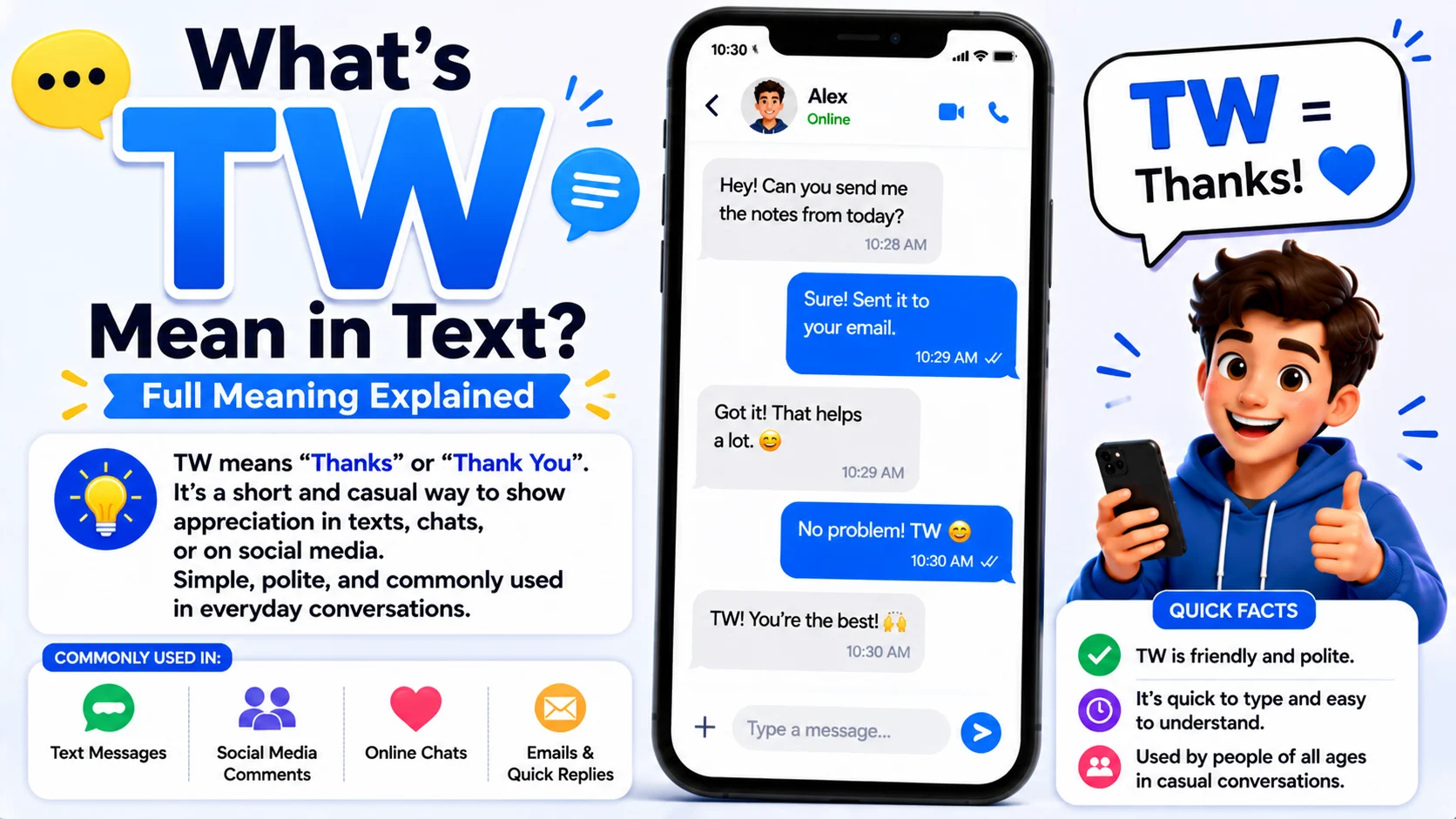
In texting and online communication, TW usually means “Trigger Warning.”
A trigger warning is a short alert that warns people about content that may be emotionally disturbing, upsetting, or traumatic.
People often place “TW” before discussing topics like:
- Violence
- Abuse
- Self-harm
- Eating disorders
- Death
- Trauma
- Graphic content
Common examples
“TW: anxiety discussion”
“TW for blood in the next slide.”
“TW // mentions of depression.”
The purpose is not censorship. It is consideration.
It gives readers the chance to mentally prepare or skip content that may affect them emotionally.
Origin & Background of TW
The phrase “trigger warning” originally became popular in online mental health forums and trauma support communities during the early internet era.
The word “trigger” comes from psychology. It describes something that causes an intense emotional reaction connected to past trauma or distressing experiences.
Over time, internet users shortened “trigger warning” into “TW” because texting culture naturally favors quick abbreviations.
Social media platforms accelerated its popularity, especially:
- TikTok
- Tumblr
- Twitter/X
- Discord
In the 2010s, TW became strongly associated with mental health awareness and digital empathy.
Today, it has evolved into mainstream internet language. Even people outside mental health communities now use it casually before sensitive discussions.
Interestingly, the meaning has also broadened. Some users now jokingly use “TW” before harmless topics for humor, such as:
“TW: bad cooking skills.”
“TW: my singing voice.”
That shift shows how internet slang constantly evolves between serious and playful usage.
Real-Life Conversations Using TW
WhatsApp Conversation
Person A:
I finally watched that documentary last night.
Person B:
Was it good?
Person A:
Yeah, but TW for violence and emotional abuse. Some scenes were hard to watch.
Instagram DM
Person A:
Did you see her story?
Person B:
Not yet.
Person A:
TW before you watch it. She talks about anxiety attacks pretty openly.
TikTok Comments
Person A:
This video needs a TW honestly.
Person B:
Agreed. The accident footage was unexpected.
Text Message
Person A:
TW: grief talk
Today’s harder than usual. Missing my dad a lot.
Person B:
I’m here for you anytime.
These examples show how TW often creates emotional awareness before deeper conversations begin.
Emotional & Psychological Meaning of TW
“TW” is more than internet slang. It reflects how modern communication has become emotionally aware.
People use trigger warnings because they recognize that words, images, and stories can affect others differently.
For someone with past trauma, unexpected content can create:
- Anxiety
- Panic
- Emotional distress
- Flashbacks
- Mood shifts
A simple “TW” helps create emotional boundaries online.
Psychologically, it also signals empathy. It tells readers:
“I respect your emotional experience.”
In many ways, TW culture represents a shift toward more emotionally intelligent communication.
A relatable scenario
Imagine scrolling TikTok late at night after a stressful day. Suddenly, a graphic video appears without warning. It catches you emotionally off guard.
Now compare that to seeing:
“TW: hospital footage”
That tiny warning gives your brain a moment to prepare or scroll away.
That is why many people appreciate the use of TW online.
Usage in Different Contexts
Social Media
On social media, TW is extremely common.
People add it before:
- Sensitive videos
- Trauma discussions
- Emotional storytelling
- News clips
- Graphic images
Example:
“TW: eating disorder discussion.”
TikTok creators especially use TWs in captions or opening slides.
Friends & Relationships
Among friends, TW can show emotional care.
Someone may warn a friend before discussing:
- Breakups
- Family trauma
- Depression
- Serious topics
Example:
“TW before I vent about anxiety.”
This creates a more respectful conversation dynamic.
Work & Professional Settings
TW is less common in professional workplaces, but it may appear in:
- Mental health workshops
- Academic discussions
- HR training
- Journalism
- Therapy-related environments
In formal settings, people often say “content warning” instead.
Casual vs Serious Tone
TW can be either serious or playful depending on context.
Serious usage
“TW: discussion of self-harm.”
Casual or joking usage
“TW: terrible dancing incoming.”
Tone matters heavily here.
When NOT to Use TW
Although trigger warnings can be helpful, there are situations where using “TW” may feel unnecessary or confusing.
Avoid using it for everything
Overusing TW for ordinary situations can reduce its seriousness.
Example:
“TW: homework.”
This may come across as mocking mental health language.
Professional confusion
Some workplaces or older audiences may not understand the abbreviation.
In formal writing, “content warning” may be clearer.
Cultural misunderstandings
Not every culture uses trigger warnings in the same way.
Some people may interpret it differently or see it as internet-only language.
When context already explains the topic
If everyone already understands the discussion topic, adding TW repeatedly may feel excessive.
Common Misunderstandings About TW
Mistaking it for “Twitter”
One of the most common misunderstandings is assuming TW means Twitter.
This happens because “TW” appears frequently on social platforms.
Thinking it’s always dramatic
Some people assume trigger warnings are exaggerations.
In reality, they often exist to help people manage emotional reactions respectfully.
Confusing joking use with serious use
Because many users employ TW humorously, newcomers sometimes fail to recognize serious warnings.
For example:
“TW: blood”
should be taken more seriously than:
“TW: bad selfies.”
Assuming everyone agrees on it
Online communities debate TW usage constantly.
Some strongly support it. Others think it can be overused.
That disagreement is part of modern internet culture.
Comparison Table
| Expression | Meaning | Tone | Common Use |
|---|---|---|---|
| TW | Trigger Warning | Serious/Caring | Sensitive content |
| CW | Content Warning | Neutral/Formal | General caution |
| FYI | For Your Information | Informative | Casual updates |
| NSFW | Not Safe For Work | Warning/Humorous | Explicit content |
| Spoiler Alert | Reveals story details | Playful | Movies/shows |
| Heads Up | Friendly warning | Casual | Everyday situations |
| IDC | I Don’t Care | Opposite emotional tone | Dismissive texting |
| PSA | Public Service Announcement | Informative | Advice or alerts |
Key Insight
TW stands out because it focuses on emotional preparedness rather than simple information. It reflects empathy more than convenience.
Variations & Types of TW
Here are common trigger warning variations used online:
1. TW: Violence
Warns about violent descriptions or footage.
2. TW: Blood
Alerts viewers to graphic or medical visuals.
3. TW: Self-Harm
Used before discussions involving self-injury.
4. TW: Abuse
Warns about emotional, physical, or verbal abuse topics.
5. TW: Eating Disorders
Common in mental health conversations online.
6. TW: Death
Used before grief or loss discussions.
7. TW: Anxiety
Signals emotionally intense mental health content.
8. TW: Panic Attacks
Warns readers about panic-related discussions.
9. TW: Flashing Lights
Often used in videos that may affect sensitive viewers.
10. TW: Trauma Discussion
General warning for emotionally heavy conversations.
How to Respond When Someone Uses TW
Casual Replies
- “Thanks for the warning.”
- “Appreciate the heads-up.”
- “Got it, thank you.”
Funny Replies
- “Mentally preparing myself already.”
- “Okay now I’m nervous.”
- “Thanks for protecting my peace.”
Mature Replies
- “I appreciate your consideration.”
- “Thank you for being thoughtful.”
- “I’ll read it when I’m ready.”
Respectful Replies
- “Thanks for letting me know beforehand.”
- “I value the warning.”
- “I appreciate the sensitivity.”
The best response usually acknowledges the person’s awareness and care.
Regional & Cultural Usage of TW
Western Culture
TW is widely recognized in North America and parts of Europe.
Mental health awareness movements helped normalize it online and in universities.
Asian Culture
In many Asian countries, TW usage is growing through TikTok, fandom culture, and global social media influence.
However, older generations may use it less frequently.
Middle Eastern Culture
TW exists online but may not be as deeply integrated into everyday communication.
Usage is usually strongest among younger internet users.
Global Internet Usage
The internet has made TW a nearly universal abbreviation in digital spaces.
Gaming communities, fandoms, wellness creators, and influencers use it regularly.
Gen Z vs Millennials
Gen Z
- Uses TW more naturally
- Strongly connected to emotional awareness culture
- Often combines serious and humorous usage
Millennials
- More likely to use full phrases like “content warning”
- Tend to separate serious and joke usage more clearly
Generational communication styles influence how TW is interpreted.
Is TW Safe for Kids?
Yes, the abbreviation itself is generally safe for kids because it exists to warn about sensitive content.
However, parents should still pay attention to the actual topic following the warning.
For example:
“TW: violence”
may introduce mature discussions.
TW is not harmful on its own. It is simply a caution label.
FAQs About TW Meaning in Text
What does TW stand for in texting?
TW usually stands for “Trigger Warning.”
Is TW always serious?
Not always. Some people use it humorously, but many uses are genuine and emotionally important.
What is the difference between TW and CW?
TW focuses more on emotional triggers, while CW means “Content Warning” and is broader.
Why do TikTok users say TW?
They use it to warn viewers about sensitive or graphic content before videos begin.
Can TW mean something else?
Yes. In some contexts, it may mean “Twitter” or other phrases, but “Trigger Warning” is now the most common meaning online.
Is using TW respectful?
Usually yes. Most people see it as considerate and emotionally aware communication.
Should I use TW in professional emails?
Generally no. In formal environments, “content warning” sounds more professional and universally understood.
Conclusion
The meaning of “TW” in text may seem small, but it reflects a much larger shift in how people communicate online.
At its core, TW means “Trigger Warning,” a simple way to prepare others for emotionally sensitive content. Whether it appears in TikTok captions, WhatsApp chats, Instagram stories, or text messages, its purpose is rooted in awareness and respect.
Modern digital conversations move fast. People share personal stories, trauma, humor, and emotions constantly. A short abbreviation like TW helps create space for empathy in that fast-moving environment.
Understanding it not only helps you decode internet slang but also helps you communicate more thoughtfully online.
And now, when you see “TW” before a post or message, you’ll know exactly what it means and why people use it.