
If you have ever received a message ending with three dots like “okay…” or “I guess…” you may have wondered what the person really meant.
The symbol ellipsis (…) looks simple, but in texting and online conversations, it often carries emotional meaning beyond grammar. It can show hesitation, curiosity, suspense, sadness, awkwardness, or even an unfinished thought.
People search “what does ellipsis mean in text” because digital conversations do not include facial expressions, voice tone, or body language. A few dots can completely change how a message feels.
Understanding ellipsis helps you read messages more accurately and avoid unnecessary misunderstandings. The same three dots can mean different things depending on the relationship, situation, and emotional tone.
What Does Ellipsis Mean in Text? Quick Meaning
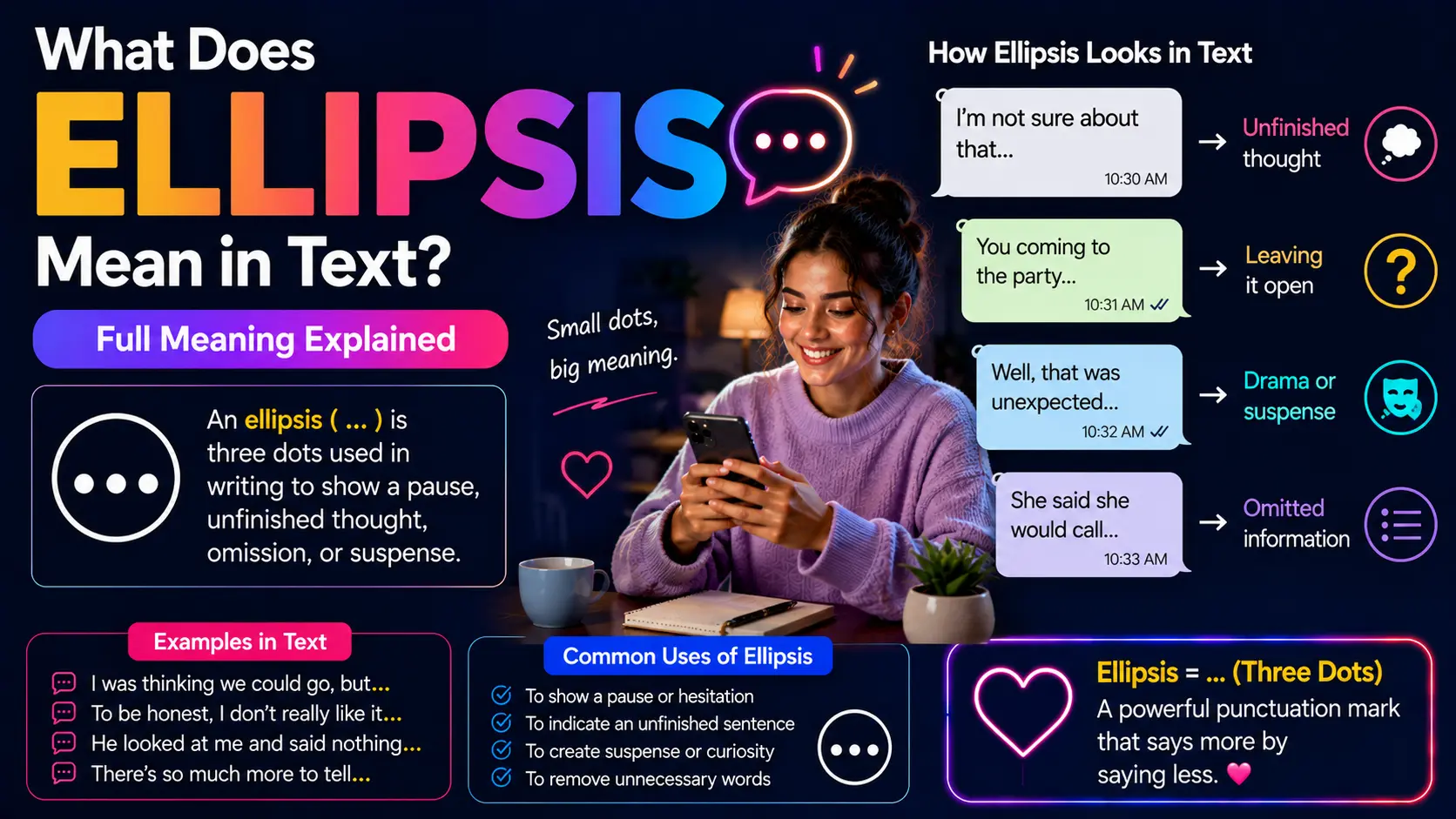
An ellipsis in text is a set of three dots (…) used to show that something is missing, unfinished, or intentionally left open.
In everyday texting, it can mean:
- A pause in thought
- Uncertainty or hesitation
- Something left unsaid
- Suspense or curiosity
- A softer emotional tone
Examples:
“I don’t know…”
This may show uncertainty or hesitation.
“You really did that…”
This can express surprise, disappointment, or disbelief.
“Maybe we should talk…”
This may suggest the person wants a serious conversation.
In modern texting, ellipsis is not only punctuation. It has become a way to express feelings.
Origin and Background of Ellipsis
The word ellipsis comes from the Greek word meaning “omission” or “leaving out.” In traditional writing, it was used to show that words had been removed from a sentence or that a thought was incomplete.
For example:
“The stars, the moon, the night…”
The writer leaves the idea open for imagination.
Over time, ellipsis became common in literature, journalism, and everyday writing. Authors used it to create mystery, emotion, and dramatic pauses.
With the rise of texting, social media, and online messaging, ellipsis gained new meanings. A person typing “sure…” is not always leaving out words. They may be showing doubt, annoyance, or hesitation.
Platforms like WhatsApp, Instagram, and TikTok changed how people use punctuation. Short messages rely heavily on symbols to replace emotional signals that normally come from speaking.
Real-Life Conversations Using Ellipsis
WhatsApp Conversation
Person A:
Are you coming to the party tonight?
Person B:
I don’t know…
Person A:
Everything okay?
Person B:
Yeah, just feeling tired.
Here, the ellipsis shows uncertainty and a pause before answering.
Instagram DM Conversation
Person A:
Your new photo looks different.
Person B:
Different… good or bad?
Person A:
Different in a good way 😂
The dots create curiosity and emotional tension.
TikTok Comment Conversation
Person A:
This video changed my whole perspective…
Person B:
Same honestly. I wasn’t expecting that.
The ellipsis creates a reflective, emotional feeling.
Text Message Conversation
Person A:
We need to talk…
Person B:
That sounds serious.
The dots create suspense because the reader expects something important afterward.
Emotional and Psychological Meaning of Ellipsis
Ellipsis often reveals the emotional space between words.
People use it when they want to communicate something without saying everything directly.
It can represent:
Hesitation:
“I was thinking…”
The person may be choosing their words carefully.
Sadness:
“I miss those days…”
The dots create a feeling of nostalgia.
Awkwardness:
“So… what now?”
The pause shows uncertainty.
Softness:
“Okay…”
Instead of sounding direct, the message feels gentler.
From a communication perspective, ellipsis is a digital version of a pause in real conversation.
For example, when someone says, “Well…” in person, their voice tells you how they feel. In texting, the dots often replace that pause.
Usage of Ellipsis in Different Contexts
Social Media
On social platforms, ellipsis is often used to create curiosity.
Example:
“Something exciting is coming…”
This encourages people to keep reading.
Friends and Relationships
Friends may use ellipsis to express emotions indirectly.
Example:
“I thought you would remember…”
The message may contain disappointment without saying it directly.
Work and Professional Settings
In professional communication, ellipsis should be used carefully.
Example:
“Please review the document…”
This may sound polite, but depending on the situation, it can also appear impatient.
Clear sentences are usually better at work.
Casual vs Serious Tone
Casual:
“Guess what…”
This creates excitement.
Serious:
“We need to discuss something…”
This creates importance.
The meaning depends on the surrounding conversation.
When Not to Use Ellipsis
Although ellipsis is common, it is not always helpful.
Avoid using it when:
- Giving important instructions
- Writing formal emails
- Communicating deadlines
- Discussing serious issues where clarity matters
For example:
“Your application was rejected…”
This may sound cold or dramatic.
A clearer sentence would be:
“Your application was not accepted at this time.”
Cultural differences also matter. Some people see repeated dots as emotional, while others see them as passive-aggressive.
Common Misunderstandings About Ellipsis
Mistake 1: Thinking It Always Means Something Negative
Not every “…” shows sadness or anger.
“I’m coming…”
may simply mean the person is typing slowly.
Mistake 2: Reading Too Much Into It
People have different texting styles. Some naturally use ellipsis often.
Mistake 3: Confusing Literal and Emotional Meaning
The literal meaning is “unfinished thought.”
The emotional meaning depends on context.
Example:
“Interesting…”
Could mean:
- Truly interested
- Doubtful
- Surprised
- Unimpressed
Comparison Table: Ellipsis and Similar Expressions
| Expression | Meaning | Common Feeling |
|---|---|---|
| Ellipsis (…) | Pause or unfinished thought | Uncertainty, emotion, suspense |
| “…” after a word | Extra emotional weight | Doubt or reflection |
| Hmm | Thinking or hesitation | Curiosity |
| Okay | Agreement | Neutral |
| Okay… | Agreement with possible emotion | Doubt or concern |
| Period (.) | Complete statement | Directness |
| “Wait…” | Pause before reaction | Surprise |
Key Insight
Ellipsis is not just punctuation. In digital conversations, it works like an emotional signal. The meaning comes from the relationship, timing, and situation.
Variations and Types of Ellipsis in Text
1. Thoughtful Ellipsis
Meaning: Showing deep thinking.
Example:
“I wonder if…”
It suggests reflection.
2. Suspense Ellipsis
Meaning: Creating curiosity.
Example:
“You won’t believe this…”
It builds anticipation.
3. Emotional Ellipsis
Meaning: Showing feelings without explaining them.
Example:
“I miss you…”
It adds emotional softness.
4. Hesitation Ellipsis
Meaning: Uncertainty before speaking.
Example:
“I guess…”
It shows doubt.
5. Dramatic Ellipsis
Meaning: Adding impact.
Example:
“And then everything changed…”
Common in storytelling.
6. Awkward Ellipsis
Meaning: Showing discomfort.
Example:
“So…”
Used when someone does not know what to say.
7. Passive Ellipsis
Meaning: Indirect criticism or disappointment.
Example:
“That was an interesting choice…”
The tone depends on context.
8. Friendly Ellipsis
Meaning: Making a message softer.
Example:
“See you later…”
It sounds warmer.
9. Romantic Ellipsis
Meaning: Adding emotional mystery.
Example:
“I wish you were here…”
10. Digital Reaction Ellipsis
Meaning: Showing a pause before responding.
Example:
“Wow…”
Often used online.
How to Respond When Someone Uses Ellipsis
Casual Replies
- “What happened? 😂”
- “Tell me more”
- “Wait, what do you mean?”
Funny Replies
- “Those three dots are making me nervous 😂”
- “The dots are telling a whole story”
- “Should I be worried? 😅”
Mature Replies
- “I feel like there is more you want to say.”
- “Take your time, I’m listening.”
Respectful Replies
- “Is everything okay?”
- “Would you like to talk about it?”
Regional and Cultural Usage of Ellipsis
Western Culture
In many Western online conversations, ellipsis often shows hesitation, sarcasm, or emotional pauses.
Example:
“Okay…”
can sound uncertain.
Asian Culture
In many Asian online communities, ellipsis may be used more frequently to soften messages and avoid sounding too direct.
Middle Eastern Culture
In some Middle Eastern digital conversations, emotional expression is often strong, and ellipsis may add seriousness or hesitation.
Global Internet Usage
Because online communication crosses cultures, the same dots may have different meanings between people.
Understanding the person matters more than the symbol.
Gen Z vs Millennials
Gen Z often uses punctuation creatively.
A simple “okay.” may feel serious, while “okay…” may feel emotional.
Millennials may use ellipsis more traditionally to show pauses or unfinished thoughts.
Is Ellipsis Safe for Kids?
Yes, ellipsis itself is harmless.
However, children and teenagers should understand that punctuation can create misunderstandings online.
A message like “fine…” may sound negative even if the sender did not intend it that way.
Teaching context awareness helps young people communicate clearly.
Frequently Asked Questions
What does three dots mean in texting?
Three dots (…) usually mean a pause, unfinished thought, hesitation, or something left unsaid.
Is ellipsis rude in text messages?
Not always. It depends on the situation and relationship. Sometimes it sounds emotional or uncertain.
Why do people end messages with dots?
People use dots to create a pause, soften words, show feelings, or build suspense.
Does “okay…” mean something bad?
It can. It may show doubt, disappointment, or hesitation, but context matters.
What is the difference between “okay” and “okay…”?
“Okay” sounds direct. “Okay…” suggests there may be extra emotion behind the response.
Is ellipsis used in professional writing?
Yes, but it should be limited. Clear communication is usually better in professional settings.
Can ellipsis show sadness?
Yes. Many people use it to express emotions they do not want to say directly.
Conclusion
Ellipsis may look like three simple dots, but in modern communication, it carries a lot of emotional meaning.
When someone writes “…” they may be thinking, hesitating, feeling something deeply, or simply leaving space for the reader to interpret.
The best way to understand ellipsis is to look beyond the punctuation. Consider the person, the conversation, and the emotion behind the message.
Used wisely, ellipsis can make digital conversations feel more human, expressive, and connected.